
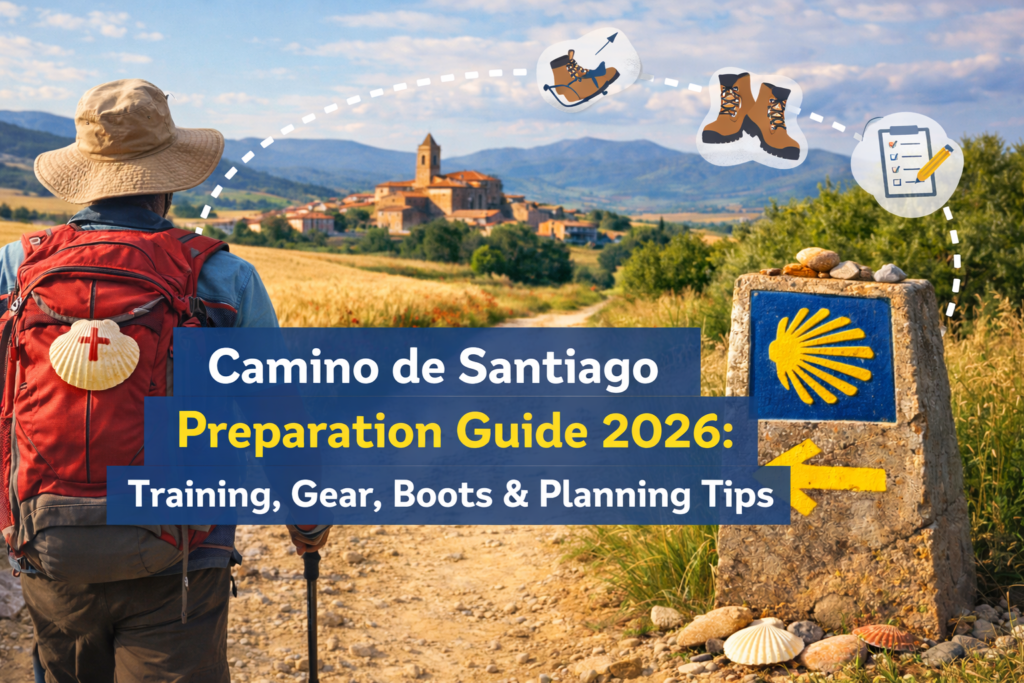
Camino de Santiago Preparation Guide 2026: Training, Gear, Boots & Planning Tips
🛫 Planning your own adventure? 🏨 Book hotels with Agoda | 📱 Stay connected with Airalo (10% off) | 🎟️ Book tours & activities on Klook
📸 Follow our journey: Instagram @angeandzee | TikTok @angeandzee
We’ve booked the flight. Paris in 2026 is confirmed — 25,000 Flying Blue miles per person, $140 CAD in taxes, two seats on Air France from Vancouver to Charles de Gaulle. From Paris we’ll take the train south to Saint-Jean-Pied-de-Port, the small medieval town in the French Basque Country where the Camino Francés begins.
And then we walk 800 kilometres to Santiago de Compostela.
We are excited. We are slightly terrified. And we are preparing — seriously, deliberately, and with the same methodical approach that we brought to the points strategy that funded our 100-day Asia trip.
The Camino de Santiago is not a walk you can fake. Every year a meaningful percentage of pilgrims who arrive in Saint-Jean-Pied-de-Port are forced to stop within the first week — blisters that became infected, knees that gave out, bodies that simply weren’t prepared for the daily reality of 20–25 kilometres on foot with a loaded pack. The difference between finishing the Camino and not finishing it is almost always made in the months of preparation before you ever leave home.
This is our honest, in-progress preparation guide — what we’re doing, what we’ve learned, what we’re still figuring out, and everything we’d tell someone standing at the beginning of their own Camino preparation journey.
Understanding What You’re Actually Preparing For
Before the training plan and the gear list, it’s worth being honest about what the Camino Francés actually demands — because most people significantly underestimate it until they’re on it.
The numbers: 800 kilometres total. Approximately 30–35 daily stages averaging 20–25 kilometres each. Walked on consecutive days, with no rest days built into the traditional stage structure (though you can take them). Total elevation gain across the full route runs to approximately 16,000 metres — accumulated across dozens of climbs and descents rather than concentrated in a few dramatic ascents.
The first day: Saint-Jean-Pied-de-Port over the Pyrenees to Roncesvalles. 25 kilometres. 1,400 metres of elevation gain. On day one. With a full pack. On legs that haven’t yet adapted to Camino walking. This stage alone causes a disproportionate number of the injuries and dropouts that happen in the first week — people who were fit enough for normal life but whose bodies weren’t ready for that specific combination of distance, elevation, and pack weight on the opening day.
The middle: The meseta — the high central plateau of Spain between Burgos and León — is psychologically as much as physically challenging. Days of flat walking through vast open landscape with little shade and few landmarks. Beautiful in its own way, but demanding a mental resilience that physical training alone doesn’t develop.
The end: Galicia’s hills in the final stages are deceptively hard — the body is tired from weeks of walking, the terrain is undulating, and the emotional weight of knowing the end is close creates its own kind of pressure.
Knowing all of this doesn’t make the Camino intimidating — it makes preparation meaningful. Every training walk, every blister prevention measure, every gram removed from your pack is an investment in a specific future experience. That specificity makes the preparation feel purposeful rather than generic.
Physical Training: Building the Body the Camino Needs
We have started walking regularly and are working up to longer distances — which is exactly the right approach at this stage of preparation, provided the progression continues deliberately and consistently through to departure.
The Core Principle: Specificity
The most important principle in Camino training is specificity — your body needs to prepare for the specific demands of the Camino, not just general fitness. Running improves cardiovascular fitness but doesn’t prepare your feet, ankles, and knees for the repetitive impact of long-distance walking in boots with a loaded pack. Gym sessions build strength but don’t develop the particular muscular endurance of consecutive walking days.
The only real preparation for walking the Camino is walking — with increasing distance, increasing pack weight, and eventually consecutive days that simulate the Camino’s daily structure.
The Training Progression We’re Following
Months 1–3 (Current phase): Base building
- Walking 5–7 days per week, starting at comfortable distances of 8–12 kilometres
- Gradually increasing distance — adding no more than 10% per week to avoid overuse injuries
- Walking on varied terrain where possible — hills, uneven surfaces, trails rather than flat pavement
- Beginning to walk in the actual boots we’ll use on the Camino — critical for the break-in process
Months 4–6: Building volume
- Regular walks of 15–20 kilometres
- Introducing the pack — starting light (3–4kg) and gradually adding weight toward the target pack weight
- Weekend back-to-back walks — 15km Saturday, 15km Sunday — to begin adapting to consecutive days
- Increasing elevation in training walks wherever Vancouver’s geography allows — the North Shore trails are perfect for this
Months 7–9: Camino simulation
- Regular 20–25 kilometre walks with full pack weight
- Multi-day walking trips — 3 to 5 consecutive days of 20km+ to genuinely simulate Camino conditions
- Focus on any problem areas that have emerged — specific muscle groups, hot spots on feet, pack fit issues
- Fine-tuning gear based on what the long training walks reveal
Final month: Taper
- Reduce volume while maintaining some activity
- No new gear, no new footwear — everything should be familiar and tested
- Focus on rest, nutrition, and mental preparation
Strength Training to Support the Walking
Walking alone isn’t sufficient — targeted strength work specifically supporting the demands of long-distance hiking makes a meaningful difference in injury prevention and recovery.
Quads and glutes — the primary muscles absorbing impact on descents, which is where most Camino knee injuries originate. Squats, lunges, and step-downs specifically train the eccentric control that descending demands.
Calves and ankles — calf raises, single-leg balance work, and ankle stability exercises prepare the lower leg for the cumulative demands of months of daily walking.
Core — a strong core reduces back fatigue from carrying a pack and improves posture over long walking days. Planks, dead bugs, and bird-dogs are more useful than crunches for this specific purpose.
Hip flexors — stretching and strengthening the hip flexors reduces the lower back tension that long walking days accumulate. Yoga or dedicated stretching sessions 2–3 times per week are worth building into the training routine.
The Boots: The Single Most Important Decision You Will Make
Everything else on the gear list matters. The boots matter more than everything else combined.
Blisters — the primary reason people suffer on the Camino and the most common cause of early departure — are almost always a boot problem. Wrong size, wrong width, wrong construction for your specific foot shape, insufficient break-in time, or simply the wrong boot for the terrain and conditions. Getting boots right is not optional.
What We’re Looking For
Trail runners vs hiking boots: This is the great Camino gear debate and experienced pilgrims line up firmly on both sides. Traditional hiking boots offer ankle support and durability; modern trail runners are lighter, dry faster when wet, and many experienced Camino walkers swear by them for the Camino’s mostly well-maintained paths.
We are leaning toward low-cut trail runners or light hiking shoes rather than heavy traditional boots for the Camino Francés specifically — the route is well-maintained, ankle-breaking terrain is limited, and the weight saving across 800 kilometres of walking is significant. But this decision will be finalised only after extensive in-store fitting and testing.
The Fitting Process
Never buy Camino boots online without trying them first. The fitting process matters enormously:
- Go to a specialist outdoor retailer, not a general sports store — staff who understand hiking footwear are essential
- Go in the afternoon when your feet are slightly swollen — feet expand during walking and afternoon sizing reflects this better
- Bring the socks you’ll actually walk in — thick merino wool hiking socks change the fit significantly from regular socks
- Test the toe box specifically — you need approximately a thumb’s width between your longest toe and the end of the boot to prevent the black toenails that are a Camino rite of passage
- Walk up and down inclines in the store — your heel should not lift on descents
- Try multiple brands — foot shapes vary enormously and the right brand for someone else may be entirely wrong for you
Brands worth trying: Salomon, Hoka, Brooks, Altra (for wide-foot pilgrims), Merrell, and Scarpa are all well represented in the Camino community. No single brand is universally correct.
Breaking In: Non-Negotiable
Whatever boots you choose, they must be broken in before Saint-Jean-Pied-de-Port. Not slightly broken in — thoroughly, completely, comfortable-for-25-kilometre-days broken in. The Camino is not a break-in environment.
Start wearing your chosen boots for all training walks immediately after purchase. Log hundreds of kilometres in them before the Camino begins. Any hot spots or pressure points that emerge during training walks indicate a fit problem that needs to be resolved — either through different lacing techniques, insoles, or different boots entirely — while you still have time to fix it.
The Pack: The Second Most Important Decision
The weight on your back compounds every kilometre you walk. A pack that feels manageable on day one feels significantly heavier by day twenty. The Camino community’s unanimous wisdom on this: your pack should weigh no more than 10% of your body weight, and lighter is always better.
What We’re Targeting
We are targeting a base pack weight of 6–8 kilograms including water — aggressive by casual hiking standards, achievable with deliberate gear selection.
The pack itself should be a dedicated hiking pack of 30–40 litres — large enough to carry everything you need, small enough to enforce the discipline of not carrying what you don’t. Osprey, Gregory, and Deuter are the most consistently recommended brands in the Camino community. Fit matters as much as brand — the pack must sit correctly on your specific torso length and hip structure.
What Goes In the Pack
The Camino gear list is the subject of endless discussion in pilgrim communities and the specifics evolve with experience. The general principles are consistent:
Clothing — the absolute minimum:
- 2–3 sets of walking clothes (quick-dry synthetic or merino wool)
- 1 set of non-walking clothes for evenings in albergues
- Rain jacket — non-negotiable on the Camino regardless of season
- Fleece or light insulating layer for mountain stages and cool mornings
- 3–4 pairs of merino wool hiking socks — the single best anti-blister investment available
- Underwear — merino wool or synthetic, quick-dry
- Sandals or lightweight camp shoes for evenings — your feet need to breathe after a walking day
Sleeping:
- Sleeping bag liner — albergues provide bunks but not bedding; a silk or merino liner is lighter than a sleeping bag and sufficient for most of the route
- Earplugs — albergues with 30 people in a dormitory are not quiet environments
Foot care — this category saves Caminos:
- Blister kit (more on this below)
- Spare laces
- Insoles if needed for your specific foot type
Navigation and documentation:
- Credencial (pilgrim passport) — obtained in Saint-Jean-Pied-de-Port or before departure; stamped at each albergue to document your journey and ultimately qualify for the Compostela certificate
- Physical guidebook — John Brierley’s guide is the standard; download the app as backup
- Passport and travel documents
- Phone and charging cable — a small power bank adds weight but is worth it
Toiletries — ruthlessly minimised:
- Travel-size everything
- Sunscreen — the meseta stages have no shade and summer sun on the Spanish plateau is relentless
- Lip balm with SPF
- Basic first aid (blister kit, ibuprofen, electrolytes)
What not to bring:
- More than 2 pairs of walking shoes/boots
- A towel larger than a microfibre travel towel
- Books (heavy; use e-reader or phone)
- More than one pair of non-walking shoes
- Anything you haven’t used on a long training walk and confirmed you actually need
The Bag Drop Option
Many pilgrims use bag transport services — companies like Jacotrans that will transport your pack from one albergue to the next for a few euros, allowing you to walk with only a small daypack. There is no shame in this and it makes the Camino accessible to people who couldn’t otherwise complete it.
We are currently planning to carry our own packs for the full route — but we’re building that decision on the evidence of our training walks rather than pride. If the training reveals that full pack carrying is problematic, the bag drop option exists and we will use it without hesitation.
Blister Prevention: The Camino’s Most Critical Subject
Blisters are the Camino’s most discussed topic for good reason — they are the most common cause of suffering, the most preventable source of serious problems, and the area where a small investment in prevention delivers the highest return.
Prevention Strategies We’re Researching
Merino wool socks — the single most impactful anti-blister decision. Merino wool manages moisture, reduces friction, and maintains its cushioning properties better than synthetic alternatives. Darn Tough and Smartwool are the most consistently recommended brands in the Camino community. Two-sock systems (a thin liner under a thicker sock) reduce friction further.
Correct boot fit — as detailed above. Most blisters trace back to boot fit problems.
Leukotape — a rigid sports tape that, applied to known hot spot areas before walking, prevents the friction that creates blisters. Many experienced Camino walkers tape specific areas of their feet preventatively every morning as a routine rather than waiting for problems to develop.
Body Glide or Vaseline — applied to friction-prone areas before walking to reduce the skin-to-sock contact that generates heat and eventually blisters.
Gradual mileage build-up — skin toughens with training. Feet that have walked hundreds of kilometres in training are significantly more blister-resistant than untrained feet arriving at the Pyrenees for the first time.
When Blisters Happen Anyway
They will. Even the most prepared pilgrims get blisters. The difference between a blister that ends a Camino and one that is managed successfully is early intervention and correct treatment.
The pilgrim community’s consensus approach: drain the blister with a sterilised needle, thread a piece of thread through it to keep the drainage channel open, apply antiseptic, cover with Compeed blister plasters (the gold standard — significantly better than standard plasters for blister management), and keep walking. The thread-through method sounds alarming and works reliably.
Albergue Strategy: Where You’ll Sleep for 35 Nights
Albergues are the pilgrim hostels of the Camino — basic accommodation in shared dormitories ranging from 6 to 100+ beds, typically costing €10–€15 per night. They are the social heart of the Camino experience, the place where the day’s walking is processed over shared dinners and where the connections that define the journey are formed.
To Book or Not to Book
The albergue booking question divides the Camino community. The traditional approach is to walk without advance bookings — arriving in each town and finding a bunk on a first-come-first-served basis, which embodies the spontaneous, trust-in-the-way spirit of the pilgrimage. The practical reality in high season (May, June, September) is that popular albergues fill by early afternoon, which can mean either walking further than planned to find a bunk or paying significantly more for private accommodation.
Our approach will be a middle path: book the first few nights — particularly the critical first stage from Saint-Jean to Roncesvalles, where accommodation is genuinely limited and competition intense — and leave most of the route more flexible. This preserves spontaneity while avoiding the specific anxiety of the opening stages.
Municipal vs Private Albergues
Municipal albergues (run by local councils or the church) are typically the cheapest option and often the most characterful — simple, traditional, and authentically Camino. First-come-first-served, no advance booking.
Private albergues (pilgrim-owned or commercial) offer slightly more comfort — often smaller dormitories, better facilities, sometimes breakfast included — at slightly higher cost. Most accept advance bookings.
Donativo albergues (pay-what-you-can) — a small number of albergues on the Camino operate on a donation basis, run by volunteers motivated by the pilgrimage tradition. These are often among the most memorable accommodation experiences on the route.
The Pilgrim Passport (Credencial)
The credencial is the official document of the Camino — a small cardboard passport that you collect stamps (sellos) in at each albergue, church, and café along the route. At Santiago de Compostela, presenting a credencial stamped at least twice daily in the final 100 kilometres (or from Saint-Jean-Pied-de-Port for the full route) qualifies you for the Compostela — the official certificate of completion.
The credencial can be obtained from the Pilgrim Office in Saint-Jean-Pied-de-Port before you start, or in advance from pilgrim associations in your home country. We’ll pick ours up in Saint-Jean as part of the ritual of beginning.
The Mental Preparation
The physical and logistical preparation for the Camino is the part that fills planning spreadsheets and gear lists. The mental preparation is harder to systematise and more important than most first-time pilgrims expect.
Reading and Research
We are working through the literature of the Camino — John Brierley’s guidebook for the practical framework, and the memoirs and reflections of people who have walked it for the experiential context. Reading other people’s honest accounts of what the middle of the Camino feels like — the doubt, the physical grinding, the unexpected emotional moments — builds a mental model that prevents the normalised suffering of the experience from feeling like personal failure when it arrives.
The Camino will be hard. Knowing it will be hard, specifically and in detail, means the hardness is expected rather than demoralising.
The Couple Dimension
We wrote about this in our lessons from 100 days in Asia as a couple — one of us plans, the other lives in the moment. Thirty-five consecutive days of shared physical challenge will test that dynamic in ways that our Asia trip, for all its intensity, didn’t.
We are talking about it now, before we’re on the Camino. How we’ll handle days when one person wants to push further and the other needs to stop. What our agreement is about walking together versus allowing each other to find their own pace. How we’ll navigate the emotional moments that the Camino reliably produces in ways that neither person can fully predict in advance.
The Camino has ended relationships and deepened them. We are going in with eyes open, with genuine respect for what the experience might surface, and with the confidence that 100 days of Asia travel together gave us.
The Timeline: Where We Are Now
Current status (early preparation phase):
- ✅ Flight booked — YVR to CDG on Flying Blue, 25,000 miles per person
- ✅ Walking regularly, building base fitness
- ✅ Research phase — route stages, albergue strategy, gear lists
- ✅ Reading Camino literature
- 🔄 Boot research in progress — fitting sessions planned
- 🔄 Pack selection in progress
- ⬜ Gear acquisition
- ⬜ Extended training walks with pack
- ⬜ Multi-day training trips
- ⬜ Credencial obtained
- ⬜ Departure
We’ll be documenting the entire preparation journey here and on our social channels — gear decisions, training progress, setbacks and breakthroughs — so that anyone planning their own Camino can follow along in real time rather than reading a retrospective account after the fact.
Practical Information
Starting point: Saint-Jean-Pied-de-Port, France — accessible by train from Paris (Gare Montparnasse to Bayonne, then local connection)
Duration: 30–35 days for most walkers covering the full 800km
Best time to walk: May–June and September–October — best weather balance with manageable pilgrim numbers. July–August is hot and crowded. November–March is cold, wet, and quiet.
Cost on the Camino: Budget approximately €35–€50 per person per day covering albergue accommodation, meals, and incidentals. The Camino is one of the most affordable extended travel experiences available — accommodation is cheap, pilgrim menus (three-course dinners with wine) run €10–€12, and the walking itself costs nothing.
The Compostela: The official certificate of completion, issued by the Pilgrim Office in Santiago de Compostela to pilgrims who have walked at least the final 100km (or 200km by bike) with a stamped credencial. For those who walk the full route from Saint-Jean, it represents 800 kilometres of documented effort.
Frequently Asked Questions
How fit do you need to be to walk the Camino de Santiago? Fit enough to walk 20–25 kilometres daily for 30+ consecutive days with a loaded pack. This requires specific preparation — a dedicated training program building over 6–12 months before departure — rather than just general fitness. The Camino is achievable for most reasonably healthy adults who prepare properly.
What are the best boots for the Camino de Santiago? The best boots are the ones that fit your specific feet correctly, have been thoroughly broken in, and have been tested on long training walks before departure. Trail runners or light hiking shoes are increasingly popular over traditional heavy hiking boots for the Camino Francés. Get fitted by a specialist, take your time, and break them in completely before arriving in Saint-Jean.
How heavy should your pack be for the Camino? No more than 10% of your body weight — and lighter is always better. A base pack weight of 6–8 kilograms including water is a reasonable target for most pilgrims. Every gram you remove is a gram you don’t carry for 800 kilometres.
Should you book albergues in advance on the Camino? Book the first night or two — particularly Saint-Jean to Roncesvalles where capacity is genuinely limited — and leave most of the route flexible. High season (June, September) makes some advance booking pragmatic; the rest of the year walk-in availability is generally reliable except at the most popular stages.
How do you get a pilgrim passport (credencial) for the Camino? From the Pilgrim Office in Saint-Jean-Pied-de-Port at the start of the Camino, or in advance from pilgrim associations in your home country (the Canadian Company of Pilgrims issues them in Canada). The credencial is stamped along the route and presented at Santiago for the Compostela certificate.
Can couples walk the Camino together? Yes — and it can be one of the most powerful shared experiences a couple has. Be prepared for the Camino to test your patience with each other, discuss in advance how you’ll handle different walking paces and difficult days, and go in with genuine respect for what extended physical challenge together can surface. Most couples who walk it together describe it as deeply strengthening.
Final Thoughts
We are in the early stages of preparing for something we know will be one of the most demanding and rewarding experiences of our lives. The flight is booked. The research is underway. The training has started.
The gap between where we are now and where we need to be by the time we stand at the gate of Saint-Jean-Pied-de-Port is real — and we’re treating it with the seriousness it deserves. Every training walk, every gear decision, every kilometre of preparation is an investment in a specific future morning when we put on our packs, face the Pyrenees, and take the first step.
We’ll document every part of the preparation journey here and on our social channels. If you’re preparing for your own Camino, we hope this helps. If you’ve already walked it and have advice — genuinely, please share it. We are listening to everyone who has been there before us.
Buen Camino.
For our full 2026 Europe vision, read our Camino and Europe travel plans. For how we booked our Paris flight on Flying Blue miles, read our Brim Flying Blue card review.
Follow the preparation journey: Instagram @angeandzee | TikTok @angeandzee