
What We Miss About Asia After 100 Days: Coffee, People, Food & The Energy
🛫 Ready to experience it yourself? 🏨 Book hotels with Agoda | 📱 Stay connected with Airalo (10% off) | 🎟️ Book tours & activities on Klook
📸 Follow our journey: Instagram @angeandzee | TikTok @angeandzee
We have been home for a while now. The bags are unpacked. The jet lag is a memory. Vancouver is doing what Vancouver does — beautiful, calm, quiet, expensive, and closing its restaurants at 10pm like somewhere that has decided the evening is finished.
And we miss Asia every single day.
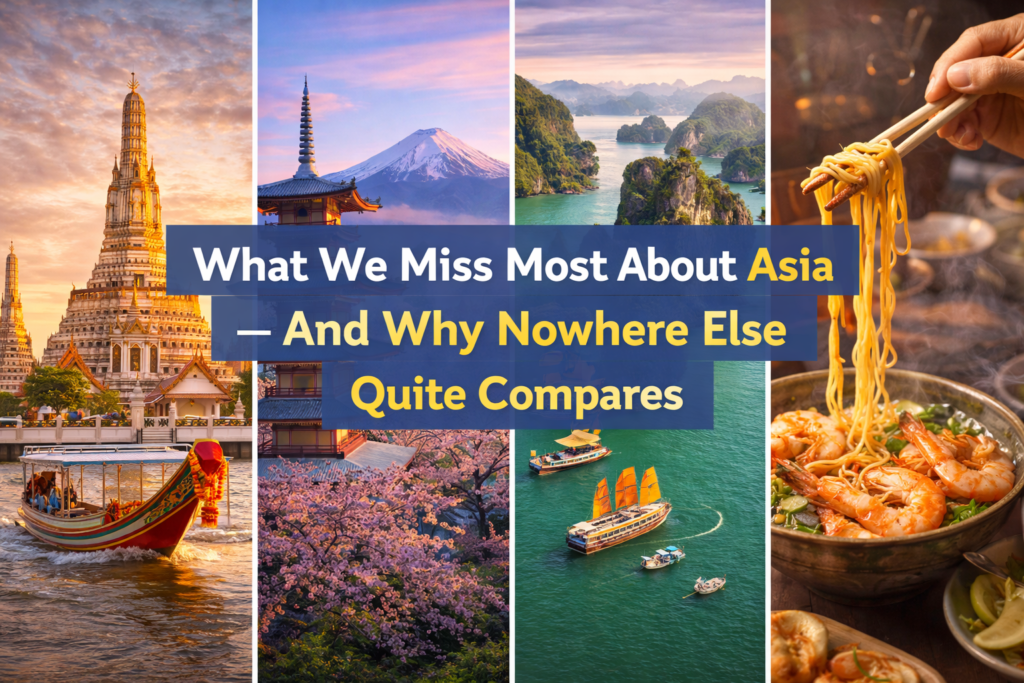
Not in a way that makes us ungrateful for home. Vancouver is extraordinary and it is ours and we love it. But there is something about the specific texture of daily life across Vietnam, Thailand, Hong Kong, China, and South Korea that gets under your skin in a way that doesn’t wash off when you step back through your own front door. A quality of energy, of warmth, of abundance, of the city always being on and always offering something — that we have not found a substitute for in any Canadian city, however much we’ve looked.
This is our honest account of what we miss. Not the famous landmarks or the bucket list experiences — those are in the guidebooks. The small, daily, irreplaceable things that made 100 days in Asia feel like living rather than visiting.
The Coffee in Vietnam — Nothing Has Come Close Since
We need to start here because the Vietnamese coffee situation is genuinely not something that Vancouver, for all its excellent café culture, has managed to replicate.
Vietnamese coffee is a distinct tradition — slow-drip robusta beans through a small metal phin filter, intensely strong, served either hot over condensed milk or cold over ice in the form of cà phê sữa đá. The result is something richer, more intense, and more interesting than almost anything you’ll find in a North American coffee shop — and it costs less than $2.
We sat on tiny plastic stools on Da Nang streets at 7am with coffees that cost 30,000 Vietnamese dong — approximately $1.50 CAD — and watched the city wake up. We took the egg coffee class at Le Caph in Saigon and learned to make the extraordinary Hanoi invention of whisked egg yolk and sugar beaten with condensed milk and poured over strong coffee — a drink that sounds alarming and tastes like the best thing you’ve ever had. We ordered iced coffees from Grab at 11pm when the desire for caffeine arrived and delivery appeared at the door in 15 minutes.
Vietnamese coffee culture is not just about the drink. It is about the sitting, the slowing down, the particular pleasure of a coffee that costs almost nothing and tastes like it costs everything, consumed in a plastic chair on a pavement while the world moves around you. It is a daily ritual that costs less than a Canadian parking meter and delivers more satisfaction than a $7.50 Vancouver flat white served in a cup that feels apologetic about its own existence.
We now pay $7–$8 minimum for coffee in Vancouver and think about those plastic stools every single time.
The People in Thailand — Warmth That Stays With You
Every country we visited had its own relationship with strangers. Vietnam was bustling and entrepreneurial — vendors quick to engage, locals curious about where you were from. Hong Kong was efficient and professional. China was warming and complex. South Korea was stylish and helpful.
But Thailand was something else.
The warmth of Thai people toward visitors is not a travel cliché — it is a genuine cultural phenomenon that you feel immediately and remember long after you’ve left. Not the performed friendliness of hospitality industry training, but the specific warmth of people who seem genuinely pleased that you’ve come to their country, genuinely interested in where you’re from and what you think of their home, and genuinely invested in ensuring you have a good experience.
Strangers striking up conversations unprompted. Restaurant owners sitting with us after service to talk about where we’d been and where we were going. People going significantly out of their way to help with directions, recommendations, and the dozen small logistical moments where a traveller without the language needs assistance. The consistent kindness of being somewhere that treats visitors as welcome guests rather than tolerated consumers.
Coming home to Vancouver — a city of relative strangers, of averted eyes on public transport, of the particular Canadian reserve that keeps interactions professional and pleasant but rarely warm — the contrast was striking. Vancouver is not unfriendly. But it is not Thailand. Nowhere we have been is quite Thailand.
The Peking Duck in Beijing — A Meal That Redefined a Dish
We had eaten Peking duck before. In Vancouver, in other Chinese restaurants across North America, enough times to think we understood what it was.
Beijing corrected that misunderstanding thoroughly.
Peking duck in Beijing — the real thing, at a proper Beijing restaurant, carved tableside and served with fresh pancakes, sliced spring onion, cucumber, and hoisin sauce — is so substantially different from its overseas interpretations that the two dishes share a name and little else. The skin is lacquered and crisp in a way that requires the specific technique and dedicated ovens of a restaurant that has been making this dish for decades. The pancakes are fresh and delicate. The ceremony of the carving and the assembly of each piece is part of the experience as much as the flavour.
We ate it more than once in Beijing and would have eaten it more still if our schedule had allowed. The memory of the first bite — that specific combination of crackling skin, tender duck, and the cool sharpness of spring onion against the sweetness of hoisin — is the kind of food memory that rewrites your understanding of what a dish can be.
Vancouver has good Chinese food. Vancouver does not have Beijing Peking duck. This is simply a fact we now live with.
The Energy — Cities That Never Decide the Evening Is Over
This is the hardest thing to describe to someone who hasn’t experienced it, and the thing we miss most comprehensively.
Asian cities — particularly in Vietnam, Thailand, and South Korea — operate on a relationship with time and availability that is fundamentally different from anything in Canada. The city is not something that opens in the morning and closes in the evening. It is something that is simply always on, always offering, always accommodating whatever need arrives at whatever hour.
Street Food at Midnight
In Vietnam, street food vendors set up at 10pm and serve until 3am. Not as an exception, not as a special late-night market event — as the normal operation of a food culture that doesn’t recognise the concept of being too late to eat well. Bánh mì sandwiches assembled at midnight by vendors who have been at the same corner for 30 years. Phở served at 2am to people who need it and know exactly where to go.
We ate street food at midnight in Da Nang more times than we can count and never once felt like we were doing something unusual. We were just eating, at the hour we were hungry, in a place that had food available at that hour because of course it did.
Convenience Stores With Hot Food
The convenience store culture of Vietnam, Taiwan, and South Korea deserves its own article and may eventually get one. These are not the sad, fluorescent-lit convenience stores of Canadian cities with their wilting hot dogs and pre-packaged sandwiches. They are genuine food destinations — stocked with freshly made items, hot food that is actually hot, an extraordinary range of snacks and drinks, and open 24 hours without exception.
Taiwanese 7-Elevens serve hot oden, freshly steamed buns, and decent coffee at 4am. South Korean convenience stores have entire menus of microwaveable hot food that is legitimately good. Vietnamese convenience stores carry fresh fruit, iced coffee, and enough food to constitute a complete meal at any hour of the day or night.
Coming home and standing in a Canadian convenience store at midnight — staring at a selection of chips, soft drinks, and a hot dog dispenser that looks like it has not been cleaned since 2019 — is a specific kind of cultural whiplash that takes time to adjust to.
Grab: Everything, Anywhere, Immediately
Grab is Southeast Asia’s super-app — ride hailing, food delivery, grocery delivery, and more, operating across Vietnam, Thailand, and the broader region with an efficiency and speed that makes Canadian delivery apps feel sluggish by comparison.
We used Grab for food delivery at 11pm, for rides at 6am, for grocery items in the middle of the afternoon, and for the dozen small logistical moments that a city designed around constant availability makes frictionless. The app worked. Drivers arrived quickly. Food arrived hot. Prices were reasonable. The entire system operated with a reliability and responsiveness that we have not found replicated at home.
Missing Grab in Vancouver is not just missing an app. It is missing the underlying philosophy of a city that treats convenience as a right rather than a premium service.
Night Markets Until 2am
The night markets of Taiwan, Vietnam, and South Korea are among the most purely enjoyable experiences that travel in Asia provides — and they run until well past midnight as a matter of course.
Shilin Night Market in Taipei. The walking streets of Da Nang and Hoi An. Myeongdong in Seoul on a Saturday night. These are not tourist attractions that happen at night — they are the normal evening life of cities that have decided the hours between 9pm and 2am are as worth filling with food, shopping, and social energy as any other part of the day.
We wandered night markets on dozens of evenings across the trip — eating, browsing, watching people, absorbing the particular energy of a city that has dressed itself up for the night and invited everyone to come out. Coming home to Vancouver streets that empty by 10pm on a Tuesday feels, by comparison, like everyone decided to leave the party early and forgot to tell us.
The Abundance — Fresh Fruit Everywhere, Always
This is a small thing that somehow became a large thing over 100 days.
Fresh fruit in Asia is everywhere, cheap, and extraordinary. Cut mango sold in bags on street corners for 50 cents. Dragon fruit halved and served with a spoon at breakfast spreads that cost less than a Vancouver parking hour. Fresh coconuts cracked open at beach stalls throughout Vietnam. Durian — controversial, polarising, unforgettable — available at markets from Bangkok to Taipei in forms ranging from the whole fruit to ice cream to pastries.
The quality and variety of fresh fruit available at low prices throughout Asia — as snacks, as desserts, as components of drinks and dishes — represents a daily abundance that we took for granted while we were there and now actively miss. In Vancouver, the same mango costs $3.50 at a grocery store and is not as good.
The Honest Adjustment: Coming Home to Vancouver
We want to be fair to Vancouver because it is our home and it is genuinely beautiful — the mountains, the ocean, the clean air, the safety, the friends and family who were here when we returned. Coming home mattered. Coming home was right.
But the adjustments were real and we are still making them.
The quiet at night is the most visceral. Walking through our neighbourhood at 10pm and hearing almost nothing — no street food vendors, no distant night market noise, no motorbikes, no city in conversation with itself — is a silence that feels enormous after 100 days of Asian urban life. Vancouver is not a city that happens at night in the way that Hanoi or Seoul or Bangkok happens at night. It is a city that happens during the day and then, quite sensibly, goes to sleep.
The coffee prices are a daily small grief. Eight dollars for a coffee that is perfectly good and entirely characterless. We drink it and think about plastic stools and egg coffee and the 30,000 dong iced coffee that we can still taste from memory.
The warmth and chaos — this is the most complex absence. Vancouver is not cold. But it is ordered, it is reserved, it is a city of personal space and averted glances and interactions that stay within defined parameters. The specific chaos of Asia — its noise, its proximity, its willingness to be unpredictable and generous and overwhelming all at once — is not something you can find on a Vancouver street corner. It has to be returned to.
And we will return to it.
What This Means for You
If you have not been to Asia, everything we have described is accessible to you — and probably more accessible than you think. The coffee that costs $1.50. The warmth of Thai strangers. The Peking duck. The midnight street food. The cities that treat your presence, at any hour, as something to be accommodated and fed.
If you have been to Asia and you recognise every word of this article — we see you. The adjustment back to wherever home is never fully resolves. There is always a part of you sitting on a plastic stool somewhere in Vietnam, waiting for a coffee that costs nothing and tastes like everything.
And if you are planning to go — go. Go for longer than you think you need. Go slower than the itinerary tells you to. Eat at midnight. Sit on the plastic stools. Let Thailand be warm to you. Order the egg coffee before you know what it is. Stand in a Beijing restaurant and eat the real Peking duck and understand for the first time what the dish was always supposed to be.
Asia will get under your skin. That is not a warning. It is a promise.
For the full story of our 100-day Asia trip — every hotel, every flight, every meal worth writing about — start at our Asia trip overview. For how we funded the whole thing on points, our how we saved $20,000 guide has everything.
And if this article made you want to book a flight — good. That was the point.
Follow our next adventure: Instagram @angeandzee | TikTok @angeandzee