
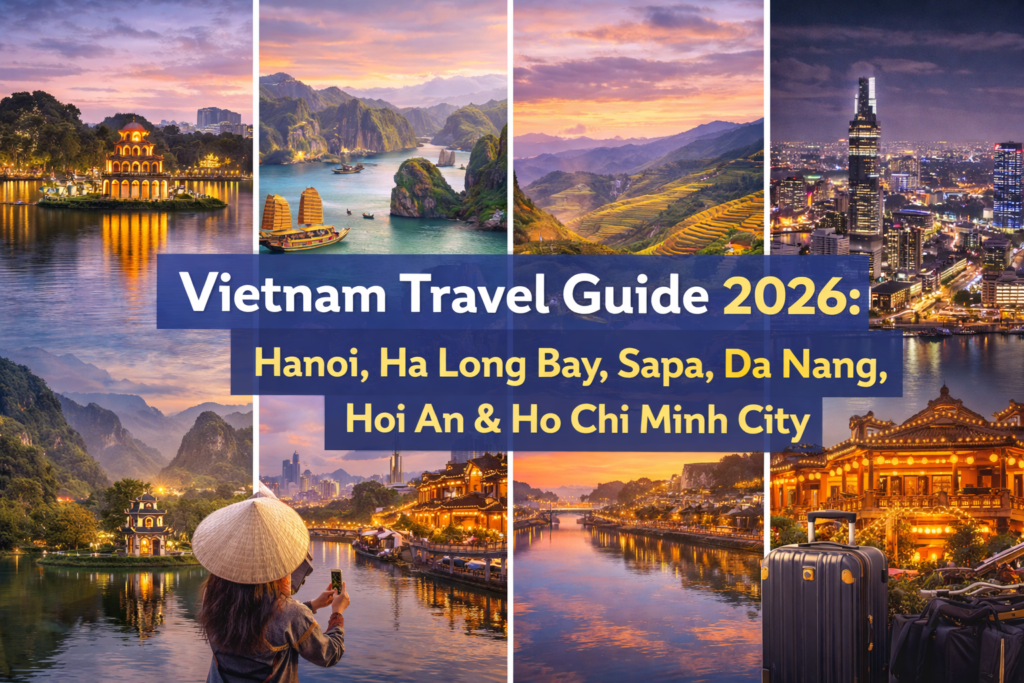
Vietnam Travel Guide 2026: Hanoi, Ha Long Bay, Sapa, Da Nang, Hoi An & Ho Chi Minh City
🛫 Planning your Vietnam trip? 🏨 Book hotels with Agoda | 📱 Stay connected with Airalo (10% off) | 🎟️ Book tours & activities on Klook
📸 Follow our journey: Instagram @angeandzee | TikTok @angeandzee
We travelled through eight countries over 100 days. We slept in luxury hotels on points from Saigon to Seoul. We ate our way through night markets and Michelin-recommended restaurants and street food stalls that charged $1 for food that tasted like it cost ten times that.
And Vietnam was our favourite. Not close.
There is something about Vietnam that resists easy description — a quality of energy and warmth and abundance and beauty that accumulates across the country’s extraordinary north-to-south range and simply overwhelms. The karst peaks rising from the sea at Ha Long Bay and Lan Ha Bay. The terraced rice fields of Sapa descending through morning mist. The ancient yellow walls of Hoi An at lantern light. The chaotic, magnificent, permanently-in-motion organism of Ho Chi Minh City. And threaded through all of it, the food — one of the world’s great culinary traditions served at plastic tables for prices that make you feel, repeatedly, like you are getting away with something.
We have written extensively about Vietnam across twelve articles on this blog. This is the guide that pulls all of it together — every destination, every food highlight, every practical detail, and the honest perspective of two Canadians who went expecting to be impressed and came home unable to stop talking about it.
Why Vietnam Belongs at the Top of Every Asia Itinerary
Vietnam is one of the most geographically diverse countries in Southeast Asia — stretching 1,650 kilometres from the Chinese border in the north to the Mekong Delta in the south, encompassing mountain ranges, UNESCO-listed bays, ancient imperial cities, French colonial architecture, and some of the continent’s most dynamic modern cities within a single country.
It is extraordinarily affordable — a budget that feels constrained in Hong Kong or Singapore funds a genuinely luxurious experience in Vietnam, particularly when points are layered on top. It is safe, easy to navigate, and increasingly well-connected by domestic flights and trains that make moving between its very different regions straightforward.
And the food. We will come back to the food repeatedly throughout this guide because it is impossible to overstate its quality, its variety, and its accessibility. Vietnam has one of the world’s great food cultures and it is available at every price point from street cart to fine dining, throughout the day and deep into the night, in every city and town and village across the country.
Vietnam at a Glance: The Regions
Vietnam divides naturally into three regions that feel distinct enough to constitute different travel experiences:
The North — Hanoi, Sapa, Ha Long Bay, Lan Ha Bay, Cat Ba Island. Mountains, karst landscapes, cooler temperatures, the country’s capital city and its particular French-inflected character. The most dramatic scenery in Vietnam is here.
Central Vietnam — Da Nang, Hoi An, Hue. The coast, the ancient town, the imperial capital. Vietnam’s culinary heartland by many accounts, and the region that balances beach access with historical depth most effectively.
The South — Ho Chi Minh City, Vung Tau, the Mekong Delta. The economic engine of the country, the most internationally facing city, the warmest weather, and the specific energy of a region that has been in constant forward motion since reunification.
A comprehensive Vietnam trip moves through all three. The domestic flight network — operated primarily by Vietnam Airlines and VietJet — makes the north-to-south journey efficient and affordable.
The North: Hanoi, Sapa, Ha Long Bay & Lan Ha Bay
Hanoi — Vietnam’s Extraordinary Capital
Hanoi is one of Southeast Asia’s great capital cities — a place where French colonial architecture, ancient temples, and the furious energy of one of the continent’s most chaotic and charming urban environments exist in permanent, productive tension.
The Old Quarter is the heart of the experience — 36 ancient trading streets named for the goods historically sold there, now a dense tangle of guesthouses, street food vendors, coffee shops, and the particular Hanoi traffic that operates by rules apparent only to participants. Walking through it at any hour is one of those travel experiences that defies summarisation — you simply have to be in it.
Egg coffee — Hanoi invented it and Hanoi does it best. The whisked egg yolk, condensed milk, and strong Vietnamese coffee combination that sounds alarming and tastes extraordinary is available throughout the Old Quarter in cafés that have been making it for generations. This is non-negotiable on any Hanoi visit.
Pho for breakfast — the correct relationship with pho in Hanoi is as a breakfast dish, eaten at 7am at a street-level restaurant with plastic stools and a broth that has been simmering since the previous evening. The northern pho is cleaner and more austere than its southern counterpart — a clear, deeply flavoured beef broth with flat rice noodles, thin slices of beef, and a restrained garnish that lets the broth speak. It is one of the world’s great breakfast foods and Hanoi is where it is at its finest.
Hoan Kiem Lake — the lake at the centre of Hanoi’s Old Quarter, with the Ngoc Son Temple on its small island reached by a red wooden bridge, is one of Vietnam’s most photographed scenes and one of its most genuinely peaceful urban spaces. Walk around it in the early morning when Hanoians come to exercise and the city is quiet.
For our full Hanoi content, read our Vietnam visa guide for entry requirements and our egg coffee and Hanoi food guide for eating recommendations.
Sapa — Rice Terraces and Mountain Trekking
Sapa is Vietnam’s most celebrated trekking destination — a mountain town in Lào Cai Province near the Chinese border, sitting at 1,500 metres elevation among some of the most spectacular rice terrace landscapes in Asia.
The terraces of the Muong Hoa Valley — carved from the mountain slopes by the Hmong, Dao, and Tay ethnic minority communities over generations — descend in layers of green and gold depending on the season, visible from the town and accessible on foot through villages that have been welcoming trekkers for decades.
Trekking options — day hikes from Sapa town are manageable independently, but multi-day treks with homestays in ethnic minority villages deliver the fuller experience that Sapa’s landscape and culture warrants. Local guides from the Hmong and Dao communities are available and recommended — their knowledge of the terrain and their community connections transform a scenic walk into a genuine cultural encounter.
We ran the Ha Long Bay Marathon through the Sapa region — an extraordinary experience that put us on the rice terrace trails at race pace and gave us views that no guided tour quite replicates. Read our Ha Long Bay Marathon and Sapa trekking guide for the full story.
Getting to Sapa: Overnight train from Hanoi to Lào Cai, then bus or taxi to Sapa — the classic route and an experience in itself. Alternatively, direct bus services from Hanoi’s My Dinh bus station run throughout the day.
Ha Long Bay and Lan Ha Bay — The Choice That Matters
Ha Long Bay is Vietnam’s most famous natural attraction — 1,600 limestone karst islands and islets rising from the Gulf of Tonkin, designated a UNESCO World Heritage Site, and the image that appears on more Vietnamese tourism material than any other. It is genuinely spectacular.
It is also genuinely crowded — particularly in high season, when the number of cruise boats operating the bay creates a traffic density that the landscape doesn’t absorb gracefully.
Lan Ha Bay — our recommendation — immediately adjacent to Ha Long Bay but administered separately, Lan Ha Bay offers the same extraordinary karst landscape with dramatically fewer boats and a more genuinely remote atmosphere. The islands, caves, and floating fishing villages of Lan Ha Bay are accessible on overnight cruises from Cat Ba Island and deliver everything Ha Long Bay promises with a fraction of the crowd.
We based ourselves on Cat Ba Island — Ha Long Bay’s largest island, with genuine infrastructure and a town that functions independently of the tourism industry — and took day and overnight trips into both bays from there. Read our complete Cat Ba Island and Lan Ha Bay guide for the full logistics and our honest comparison of the two bays.
Practical decision: If you have time for only one, choose Lan Ha Bay from Cat Ba Island. If you want the full Ha Long Bay experience specifically, book a well-regarded overnight cruise from Halong City — the quality of the boat matters enormously and the gap between a budget cruise and a mid-range one is larger here than almost anywhere else in Vietnam.
Book overnight cruises and day trips through Klook.
Central Vietnam: Da Nang & Hoi An
Da Nang — Vietnam’s Most Liveable City
Da Nang is Vietnam’s third-largest city and, by general consensus among long-term travellers and expats, its most liveable — a mid-sized coastal city with a beautiful beach, an emerging food scene, good infrastructure, and enough going on to sustain weeks of exploration without the overwhelming intensity of Hanoi or Ho Chi Minh City.
We based ourselves in Da Nang for an extended period — staying at the InterContinental Da Nang Sun Peninsula on IHG points, one of the most spectacular resort redemptions of the entire trip — and used it as the hub for both city exploration and day trips to Hoi An.
The seafood is Da Nang’s greatest culinary asset — fresh, abundant, and served in restaurants throughout the city at prices that make the quality feel implausible. Grilled prawns, clams in lemongrass, whole fish steamed or grilled over charcoal, and the specific Da Nang specialty of Mi Quang — a turmeric-yellow noodle dish with shrimp and pork and a small amount of rich broth, served with rice crackers — are the essential eating experiences of the city.
The beach — My Khe Beach, stretching along Da Nang’s eastern coast, is one of the best urban beaches in Vietnam — wide, clean, and lined with seafood restaurants that set up tables on the sand in the evenings for some of the most enjoyable casual dining of the trip.
The Ba Na Hills and Golden Bridge — the French-built hill station above Da Nang, accessible by the world’s longest non-stop single cable car, is home to the Golden Bridge — the giant stone hands holding a golden walkway that has become one of Vietnam’s most photographed images. Worth a half-day trip. Book through Klook.
Banh xeo — the sizzling Vietnamese crepe, made from rice flour and turmeric batter cooked with pork, shrimp, and bean sprouts until crackling and golden, then wrapped in lettuce leaves with fresh herbs and dipped in fish sauce — is one of Vietnam’s most satisfying dishes and Da Nang serves an excellent version throughout the city. We ate it repeatedly and never once considered stopping.
For our complete Da Nang coverage read our Da Nang travel guide, InterContinental Da Nang review, and Da Nang hotel comparison.
Hoi An — Vietnam’s Most Beautiful Town
Hoi An is Vietnam’s most visually perfect destination — a UNESCO-listed Ancient Town of yellow-walled merchant houses, red wooden bridges, tailors’ shops, and lanterns that come on at dusk and transform the town into something that looks like it was designed by someone who understood exactly what a beautiful place should look like.
It is also extremely popular, which means the Ancient Town on a Saturday evening can feel significantly more crowded than its beauty warrants. The solution is timing — early mornings before the tour groups arrive, or the quieter back streets away from the main tourist corridor, reveal Hoi An at its most atmospheric.
Custom tailoring — Hoi An’s tailor shops are famous throughout Asia and the quality justifies the reputation. Custom clothing — suits, dresses, shirts — made to measure in 24–48 hours at prices dramatically below what comparable quality costs in Canada. Allow time and be specific about what you want; the best results come from bringing reference photos and being willing to do multiple fittings.
The food — Hoi An has its own distinct culinary identity separate from the broader Vietnamese tradition. White rose dumplings (Banh Bao Vac), Cao Lau noodles (available authentically only in Hoi An, made with water from a specific local well by most accounts), and the Vietnamese version of the Banh Mi — served at Phuong’s Banh Mi shop, widely considered among the best in the country — are the essential Hoi An eating experiences.
Getting between Da Nang and Hoi An: 30 kilometres, approximately 45 minutes by taxi or Grab. The combination of Da Nang as base and Hoi An as day trip is our recommended approach — Da Nang’s hotel infrastructure and points redemption options are significantly stronger than Hoi An’s, while Hoi An’s day-trip experience is complete and deeply satisfying.
The South: Ho Chi Minh City & Vung Tau
Ho Chi Minh City (Saigon) — The City That Never Slows Down
Ho Chi Minh City — Saigon to everyone who lives there and most who visit — is one of the most energetically overwhelming cities in the world. Ten million people, approximately eight million motorbikes, a street food culture that operates 24 hours, and a pace of development and forward motion that makes the city feel like it is permanently in the process of becoming something larger than it already is.
We spent extensive time in Saigon — staying at the Vinpearl Landmark 81 on Marriott 35k certificates (in the tallest building in Vietnam, with views across the city that made every morning extraordinary), the Renaissance Saigon on points, and exploring the city’s extraordinary range of neighbourhoods, restaurants, and experiences across multiple weeks.
District 1 is the tourist heart — the backpacker streets of Pham Ngu Lao, the French colonial grandeur of Dong Khoi and the Notre-Dame Cathedral, the Ben Thanh Market and its surrounding street food concentration, and the rooftop bars that give you the city from above at golden hour.
District 3 and District 10 — moving away from the tourist centre into the city’s Vietnamese residential districts reveals Saigon’s daily life in a way that District 1 doesn’t. Local coffee shops, neighbourhood com tam restaurants, the specific texture of a city that is doing its actual business rather than performing for visitors.
Com tam and Vietnamese desserts — com tam (broken rice) served with grilled pork, a fried egg, and pickled vegetables is Saigon’s archetypal breakfast and one of the most satisfying simple dishes in Vietnamese cooking. Vietnamese desserts — che, the sweet bean and coconut milk soups served hot or cold; fresh fruit shaved ice; bánh flan (Vietnamese crème caramel with coffee) — are an entire food world that most visitors barely scratch the surface of.
The War Remnants Museum — one of the most significant museums in Southeast Asia, documenting the American War from the Vietnamese perspective with a directness and specificity that is genuinely affecting. Worth a dedicated half-day visit. Approach it with the emotional preparation it warrants.
Reunification Palace — the former Presidential Palace of South Vietnam, preserved exactly as it was on April 30, 1975 when North Vietnamese tanks crashed through its gates. A remarkable piece of living history in the centre of the city.
For our complete Saigon coverage read our Ho Chi Minh City 4-day guide, Vinpearl Landmark 81 review, and Renaissance Saigon review.
Vung Tau — Saigon’s Beach Escape
Vung Tau is the coastal city two hours from Ho Chi Minh City where Saigonese go when they want a beach weekend — a peninsula city with beaches on both sides and a particular atmosphere of a resort town that serves primarily domestic tourism rather than international visitors.
The result is a more authentically local experience than Vietnam’s more famous beach destinations — the seafood restaurants are excellent and priced for Vietnamese families rather than tourist budgets, the beaches are uncrowded by regional standards, and the giant Christ the King statue on the mountain above the city gives Vung Tau one of the most distinctive skylines in southern Vietnam.
Read our Vung Tau travel guide for the complete story.
The Vietnam Food Guide: What to Eat and Where
Vietnam’s food culture is one of the world’s great culinary traditions — regional, seasonal, obsessively fresh, and available at every price point from street cart to fine dining. These are the dishes that defined our experience.
Pho — Vietnam’s most famous dish needs no introduction but does need correct context: pho is a breakfast food, best eaten early morning at a neighbourhood restaurant, in a clear broth that has been simmering overnight. Northern pho (Hanoi) is austere and clean. Southern pho (Saigon) is sweeter and more heavily garnished. Both are transcendent.
Banh mi — the Vietnamese baguette sandwich, a legacy of French colonial influence, is available everywhere for under $1.50 CAD and at its best is one of the world’s great sandwiches — crispy baguette, pork or pâté, pickled vegetables, fresh cucumber and coriander, chilli sauce. Eat one every day. There is no such thing as too many banh mi.
Egg coffee — Hanoi’s extraordinary invention of whisked egg yolk, condensed milk, and strong Vietnamese coffee. Non-negotiable in Hanoi. We learned to make it at the Le Caph coffee class in Saigon. Read our Vietnamese coffee guide for the full story.
Cà phê sữa đá — Vietnamese iced coffee with sweetened condensed milk, available everywhere for under $2 CAD. We drank one almost every day for the duration of our Vietnam stay. Nothing in Canada comes close.
Banh xeo — the sizzling turmeric crepe stuffed with pork, shrimp, and bean sprouts, wrapped in lettuce with fresh herbs. Da Nang and the central region serve exceptional versions.
Com tam — Saigon’s broken rice, served with grilled pork and a fried egg. The correct Saigon breakfast for anyone who has already had their pho quota for the morning.
Vietnamese desserts — che (sweet bean soups), bánh flan (Vietnamese crème caramel), fresh fruit shaved ice, and the extraordinary variety of sweet snacks and drinks that Vietnamese dessert culture produces. An entire food world worth exploring.
Seafood in Da Nang — grilled over charcoal, steamed with lemongrass, prepared simply in ways that let the freshness speak. The best seafood meals of the entire trip happened at plastic tables on the Da Nang waterfront.
Where to Stay in Vietnam on Points
Vietnam has a strong points hotel ecosystem — particularly in the luxury and upper-midscale categories across the Marriott Bonvoy, IHG One Rewards, and Hilton Honors programs.
InterContinental Da Nang Sun Peninsula — the most spectacular resort redemption of the entire Asia trip. IHG points, clifftop setting above the South China Sea, award-winning architecture. Read our InterContinental Da Nang review.
Vinpearl Landmark 81 Saigon — Marriott 35k certificates in the tallest building in Vietnam. Views across Ho Chi Minh City from a height that makes the city’s scale comprehensible. Read our Vinpearl Landmark 81 review.
Renaissance Saigon — Marriott points, outstanding Platinum lounge, excellent location. Read our Renaissance Saigon review.
Check current rates across Vietnam on Agoda for cash stays, or redeem through your loyalty program portals for points stays.
Getting Around Vietnam
Domestic flights — Vietnam Airlines and VietJet connect Hanoi, Da Nang, and Ho Chi Minh City with frequent daily services. Fares are affordable and the flights make the north-to-south journey efficient. Book well in advance for the best prices.
Grab — Southeast Asia’s super-app works throughout Vietnam for rides, food delivery, and more. Set it up before arrival and use it for every taxi need — metered taxis exist but Grab’s price transparency is preferable in a country where tourist taxi pricing can be aggressive.
Trains — the Reunification Express runs the length of Vietnam from Hanoi to Ho Chi Minh City, with particularly scenic sections through the central region. Slower than flying but worth considering for the Hanoi to Da Nang or Da Nang to Saigon leg if time allows.
Motorbike taxis (xe om) — through Grab’s motorbike option, the fastest way to move through Ho Chi Minh City’s traffic. Helmet provided. The experience of weaving through Saigon traffic on the back of a motorbike is genuinely exhilarating.
Practical Information
Visa: Most Western nationalities including Canadians can obtain a Vietnam e-Visa online before departure — valid for 90 days, single or multiple entry, processed within three business days. Apply through the official Vietnam Immigration portal. Read our Vietnam visa guide for the complete step-by-step process.
Currency: Vietnamese Dong (VND). Cards accepted at hotels and larger restaurants; cash essential for street food, markets, and smaller vendors. ATMs are plentiful in cities. The exchange rate makes Vietnam feel extraordinarily affordable — $1 CAD is approximately 17,000–18,000 VND.
Language: Vietnamese. English is widespread in tourist areas and hotels throughout the country. Translation apps are useful for menus and conversations outside tourist districts.
Connectivity: Set up a Vietnam e-SIM through Airalo before arrival — use our link for 10% off. Coverage is excellent in cities and most tourist areas.
Weather: Vietnam’s climate varies significantly by region. The north has four distinct seasons — October to April is the best period for Hanoi and Sapa. Central Vietnam is best from February to August. The south is hot year-round with a wet season from May to November. The country is long enough that regional weather differences mean some part of Vietnam is always in good season.
Safety: Vietnam is very safe for travellers. Petty theft in tourist areas — bag snatching by motorbike — is the primary risk and manageable with standard awareness. Keep bags on the inside on busy streets and don’t display expensive items openly.
Vietnam Itinerary: 2 Weeks North to South
Days 1–3: Hanoi Arrive, Old Quarter exploration, egg coffee, pho breakfast, Hoan Kiem Lake, day trip planning.
Day 4: Day trip to Ha Long Bay or overnight to Cat Ba Day cruise or transfer to Cat Ba Island for overnight Lan Ha Bay cruise.
Days 5–6: Sapa Overnight train from Hanoi to Lào Cai, bus to Sapa. Two days trekking rice terraces and ethnic minority villages.
Day 7: Fly Hanoi to Da Nang Arrive Da Nang, check in, seafood dinner on the waterfront.
Days 8–9: Da Nang and Hoi An Day 8 in Da Nang — beach, banh xeo, city exploration. Day 9 day trip to Hoi An Ancient Town.
Days 10–13: Ho Chi Minh City Fly Da Nang to Saigon. Four days covering District 1, the War Remnants Museum, Reunification Palace, com tam breakfasts, rooftop bars, Vietnamese dessert exploration.
Day 14: Vung Tau day trip or depart Day trip to Vung Tau for coastal contrast before departure, or use as a final slow Saigon day.
Frequently Asked Questions
Is Vietnam safe for tourists? Yes — Vietnam is one of Southeast Asia’s safest destinations. Standard urban awareness applies in busy tourist areas; the country is very safe overall for independent travellers.
How many days do you need in Vietnam? Two weeks covers the highlights north to south. Three weeks allows a slower, deeper experience. We spent close to a month across Vietnam and could have stayed longer.
Is Vietnam cheap? Extremely — one of the most affordable destinations in Asia. Street food meals under $2, excellent local restaurants under $10 per person, and hotel costs that feel implausibly low by Canadian standards. Even luxury hotels are dramatically cheaper than comparable properties elsewhere in Asia.
What is the best time to visit Vietnam? The country is so long that no single month is perfect for everywhere. February to April is the most consistently good period across all regions. For specific regions: October to April for the north, February to August for central Vietnam, year-round for the south with preference for November to April to avoid the wettest months.
Do I need a visa for Vietnam as a Canadian? Yes — a Vietnam e-Visa is required, available online before departure. 90-day validity, straightforward application. Read our Vietnam visa guide for the complete process.
Ha Long Bay or Lan Ha Bay — which is better? Lan Ha Bay — same spectacular karst landscape, dramatically fewer tourist boats, more remote atmosphere. If you have limited time and must choose one, choose Lan Ha Bay from Cat Ba Island. Read our Cat Ba and Lan Ha Bay guide for the full comparison.
What should I eat in Vietnam? Everything. But specifically: pho for breakfast in Hanoi, egg coffee in the Old Quarter, banh mi at every opportunity, banh xeo in Da Nang, com tam and Vietnamese desserts in Saigon, fresh seafood on the Da Nang waterfront. Vietnam is one of the world’s great food destinations and it is impossible to eat badly if you eat where locals eat.
Our Vietnam Articles — The Complete Library
We have written more about Vietnam than any other destination on the blog — twelve articles covering every region, every major hotel, and every aspect of the country that made it our favourite:
- Vietnam Visa Guide — complete e-Visa process for Canadians
- Sapa Trekking and Ha Long Bay Marathon — trekking the rice terraces and running the marathon
- Cat Ba Island and Lan Ha Bay Guide — why Lan Ha Bay beats Ha Long Bay
- Da Nang Travel Guide — the complete city guide
- InterContinental Da Nang Review — the most spectacular resort redemption of the trip
- Ho Chi Minh City 4-Day Guide — the complete Saigon guide
- Vinpearl Landmark 81 Review — tallest building in Vietnam on Marriott points
- Renaissance Saigon Review — outstanding lounge and location
- Vung Tau Guide — Saigon’s coastal escape
- Vietnam Points Strategy — how we stayed at luxury hotels for free
Final Thoughts
Eight countries. 100 days. And Vietnam was the best of all of it.
Not because it is the most dramatic or the most luxurious or the most historically significant — though it is all of those things in their own measure. But because it combines everything that makes travel extraordinary — natural beauty, food culture, human warmth, the specific pleasure of a country where your money goes further than anywhere else and the people seem genuinely glad you came — into a single destination that delivers at every register.
We went expecting to be impressed. We came home unable to adequately describe how much more than impressed we were.
Go to Vietnam. Go for longer than you’re planning. Eat pho for breakfast and egg coffee at 10am and banh mi whenever hunger arrives and seafood at plastic tables on the Da Nang waterfront at night. Trek the Sapa terraces in the early morning mist. Take the overnight boat into Lan Ha Bay and wake up surrounded by limestone islands with no other boats in sight.
It will be your favourite too. We are almost certain of it.
Book tours and activities through Klook. Check hotel rates on Agoda. Stay connected with Airalo (10% off with our link).
For our complete 100-day Asia trip, start at our Asia trip overview.
Follow our journey: Instagram @angeandzee | TikTok @angeandzee