
Taiwan Travel Guide 2026: Taipei, Jiufen, Sun Moon Lake & Night Markets
🛫 Planning your Taiwan trip? 🏨 Book hotels with Agoda | 📱 Stay connected with Airalo (10% off) | 🎟️ Book tours & activities on Klook
📸 Follow our journey: Instagram @angeandzee | TikTok @angeandzee
Taiwan is the destination that consistently surprises people who visit it — a compact island that somehow contains more to eat, explore, and experience than its geography suggests possible. Mountain landscapes and cosmopolitan cities. Ancient temples and cutting-edge design. Night markets that run until midnight and café culture that approaches the subject with genuine artistic seriousness.
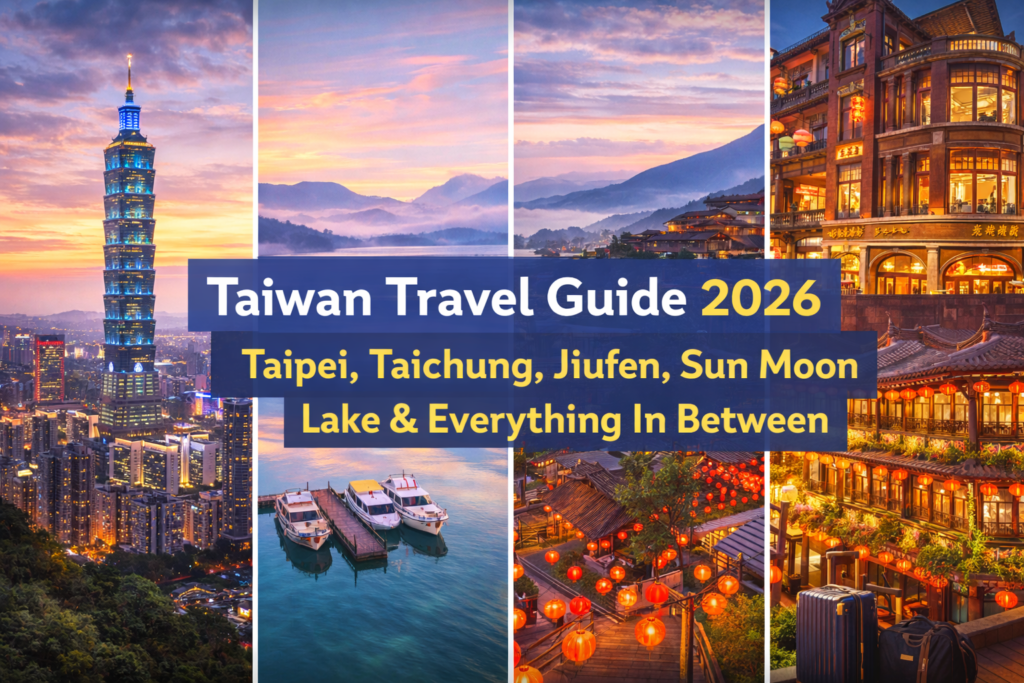
We spent time across Taipei and Taichung — staying at the Hilton Taipei Sinban on Hilton Diamond status and the Fairfield Taichung on Marriott points — and used both cities as bases for day trips that revealed a country of extraordinary depth and variety. Jiufen’s misty hillside alleyways. The mirror-calm of Sun Moon Lake in the central mountains. Shilin Night Market at full Saturday night intensity. Taipei 101 rising above the city like a bamboo stalk reaching for the sky.
This is our complete Taiwan travel guide — everything we experienced and everything you need to plan your own visit.
Why Taiwan Deserves More Attention Than It Gets
Taiwan sits in an awkward position in most travellers’ Asia planning — not as automatically famous as Japan or Thailand, not as historically weighty as China, not as cosmopolitan-famous as Hong Kong or Singapore. It tends to be added to itineraries as an afterthought or skipped entirely in favour of more familiar destinations.
This is a mistake, and the travellers who discover Taiwan firsthand tend to become its most enthusiastic advocates. The food alone — a fusion of Taiwanese, Chinese, Japanese, and indigenous culinary traditions that has produced one of Asia’s most distinctive and rewarding food cultures — justifies a visit. The people, with a warmth and openness that surprised us consistently, add another dimension. And the sheer variety of landscape and experience compressed into an island roughly the size of Vancouver Island makes Taiwan one of the most efficient travel destinations in the world.
Getting to Taiwan
By air: Taipei Taoyuan International Airport (TPE) is the main international gateway, serving flights from across Asia and beyond. Taipei Songshan Airport (TSA) handles some regional routes.
From Canada: No direct flights from Canada to Taiwan — connections through Tokyo, Seoul, Hong Kong, or other Asian hubs are standard. Air Canada, EVA Air (Taiwan’s flagship carrier and a Star Alliance member), and Cathay Pacific are the most commonly used carriers.
Aeroplan and Avios are both usable for Taiwan routings through Star Alliance and partner connections — check our Canadian travel credit cards guide for the full points strategy.
Getting Around Taiwan
Taiwan’s transport infrastructure is excellent and makes getting around the island straightforward even without Mandarin.
Taipei MRT — Taipei’s metro system is clean, efficient, bilingual, and covers the city comprehensively. An EasyCard (Taiwan’s equivalent of Hong Kong’s Octopus) handles MRT fares, buses, and Taiwan High Speed Rail tickets.
Taiwan High Speed Rail (HSR) — connects Taipei to Taichung in approximately 50 minutes and to Kaohsiung in under two hours. One of Asia’s best high-speed rail systems and the obvious way to move between Taiwan’s western corridor cities.
Buses and local trains — for destinations off the HSR network including Jiufen and Sun Moon Lake, local buses and trains provide coverage. Day tour operators through Klook make day trips to these destinations significantly easier than navigating independently.
Scooters — the dominant local transport mode throughout Taiwan. Not recommended for visitors unfamiliar with Taiwanese traffic unless you have significant scooter experience.
Taipei — Taiwan’s Extraordinary Capital
Taipei 101
Taipei 101 was, for five years, the world’s tallest building — and even after being surpassed in height it remains one of the most architecturally distinctive skyscrapers ever built. The design references bamboo segments stacked vertically, with each of the eight sections symbolising prosperity in Chinese culture. At 509 metres, the observation deck on the 89th floor offers a panoramic view of Taipei that puts the city’s geography — ringed by green mountains, threaded by rivers — into immediate perspective.
The indoor observation deck is the primary tourist experience; the outdoor deck on the 91st floor adds wind and altitude for the committed. The giant tuned mass damper inside the building — an 800-tonne steel sphere that stabilises the tower against wind and earthquakes — is visible from the 87th floor and genuinely fascinating.
Practical tip: Book tickets in advance through Klook — queues can be significant without advance purchase. The building is located in Xinyi, Taipei’s most modern district, making it easily combinable with Xinyi’s excellent shopping and dining.
Shilin Night Market — The Night Market That Sets the Standard
Shilin Night Market is Taipei’s largest and most famous night market — and the one that most thoroughly justifies Taiwan’s reputation as one of the world’s great street food destinations.
The market occupies several blocks in the Shilin district, with an underground food centre supplemented by outdoor stalls running along surrounding streets. The variety is staggering — oyster vermicelli, stinky tofu (controversial, worth trying), scallion pancakes, grilled corn, bubble tea in every permutation, fresh fruit shaved ice, and dozens of Taiwanese street food specialties that have no direct equivalent elsewhere.
What to eat at Shilin:
- Oyster omelette (蚵仔煎) — one of Taiwan’s most iconic street foods, available at dedicated stalls
- Stinky tofu (臭豆腐) — fermented tofu, deep fried, served with pickled cabbage. The smell is alarming; the taste is genuinely good once you commit
- Scallion pancake (蔥油餅) — layered flatbread, crispy and soft simultaneously
- XXL chicken cutlet (雞排) — enormous fried chicken seasoned with basil, sold from stalls throughout the market
- Bubble tea — Taiwan invented it; Shilin serves some of the best
Practical notes: Shilin is most atmospheric on Friday and Saturday evenings when it reaches full intensity. The underground food centre closes earlier than the outdoor stalls. Arrive hungry and arrive with cash.
Taipei’s Café Culture
Taiwan’s café culture deserves specific attention — it operates at a level of design consciousness and quality that makes it one of the most rewarding café scenes in Asia. Specialty coffee, beautifully designed spaces, seasonal menus executed with precision, and the particular Taiwanese attention to presentation that elevates every visual aspect of the experience.
Zhongshan District and Da’an District in Taipei are particularly dense with excellent independent cafés. Allow time for exploration — finding a beautiful café down a Taipei side street and spending an afternoon there is one of the city’s most characteristically pleasurable experiences.
Day Trip: Jiufen Old Street — Taiwan’s Most Atmospheric Village
Jiufen is a former gold mining town clinging to a hillside above Taiwan’s northeast coast — a village of narrow stone stairways, red lanterns, tea houses built on stilts over the mountain slope, and views across the Pacific that emerge between buildings and disappear around corners.
The atmosphere is particular — misty, layered, visually complex in a way that rewards slow exploration. The famous A-Mei Tea House, with its multi-level terrace overlooking the sea, is widely said to have inspired the bathhouse in Studio Ghibli’s Spirited Away. Whether or not this is precisely accurate, the visual resonance is undeniable.
What to do in Jiufen:
- Walk the main stairway (Jiufen Old Street) from bottom to top and back — the view changes with every corner
- Stop at a tea house for a traditional Taiwanese tea experience overlooking the sea
- Eat taro balls (芋圓) — Jiufen’s most famous food, served hot or cold in sweet soup
- Explore the quieter side alleyways away from the main tourist corridor
Getting there: Day tour from Taipei through Klook is the most convenient option — organised transport handles the logistics of a destination that requires a bus connection from the nearest train station. Public transport is possible but requires more time and planning.
Practical note: Jiufen can be extremely crowded on weekends — a weekday visit delivers a meaningfully quieter and more atmospheric experience. The village is most beautiful in the late afternoon when the lanterns come on before sunset.
Taichung — Taiwan’s Most Underrated City
Taichung is Taiwan’s third-largest city and, in our experience, its most underrated — a city that doesn’t appear prominently on most Taiwan itineraries but rewards the travellers who include it with excellent food, a more relaxed pace than Taipei, and the best night market in Taiwan.
We stayed five nights at the Fairfield by Marriott Taichung on Marriott Bonvoy points — 68,000 points for five nights, an excellent redemption that included complimentary breakfast as a gesture from the property. Read our Fairfield Taichung review for the full details.
Fengjia Night Market — Taiwan’s Largest and Best
Fengjia Night Market near Taichung’s Feng Chia University is by most accounts the largest night market in Taiwan — and consistently rated as the best by Taiwanese locals, which is a more reliable endorsement than any travel guide.
The market sprawls across multiple streets and alleys, running from late afternoon until well past midnight, and the food innovation here is legendary in Taiwan — new dishes and variations are developed and popularised at Fengjia before spreading to night markets elsewhere in the country. If you eat something at a Taiwanese night market and wonder where it was invented, the answer is often Fengjia.
The atmosphere is distinctly local — less tourist-facing than Shilin, more authentically embedded in the daily life of the city’s student population. This gives it a particular energy that the more famous Taipei markets don’t quite replicate.
Day Trip: Sun Moon Lake — Taiwan’s Most Beautiful Landscape
Sun Moon Lake is Taiwan’s largest lake — sitting in the mountains of Nantou County in the island’s interior, at an altitude of 748 metres, surrounded by forested peaks that descend directly to the water’s edge. The name comes from the shape of the lake: the eastern section is round like the sun; the western section is crescent-shaped like the moon.
The lake is one of Taiwan’s most popular domestic tourism destinations and justifiably so — the combination of mountain scenery, calm water, traditional Aboriginal culture from the Thao people who have lived here for generations, and the infrastructure of cycling paths, boat services, and lakeside accommodation makes it a complete destination rather than just a scenic viewpoint.
What to do at Sun Moon Lake:
- Cycle the lake circuit — a 33km path around the entire lake with multiple scenic stops and gentle elevation changes
- Take the gondola (Formosa Cable Car) across the mountains for aerial views
- Visit Wenwu Temple — dramatically situated on the northern shore with imposing entrance guardian figures
- Try the local speciality: sun moon lake black tea, grown in the surrounding hills, and served at lakeside cafés throughout the area
- Take the ferry between the main piers — the view of the lake from the water is different from and complementary to the views from shore
Getting there: Day tour from Taichung through Klook is the most efficient option from central Taiwan. From Taipei, the journey is approximately 2–3 hours combining HSR to Taichung with a bus connection.
Where to Stay in Taiwan on Points
Taipei: Hilton Taipei Sinban
We stayed at the Hilton Taipei Sinban on Hilton Diamond status — a well-positioned property with strong business rate value and a memorable check-in story involving our Hilton Diamond card. Read our full Hilton Taipei Sinban review.
Check current Taipei hotel rates on Agoda or redeem Hilton Honors points through the Hilton portal.
Taichung: Fairfield by Marriott
The Fairfield Taichung delivered excellent value on Marriott points — 68,000 points for five nights with complimentary breakfast and walking distance to Fengjia Night Market. Read our full Fairfield Taichung review.
Practical Information
Currency: New Taiwan Dollar (TWD). EasyCard handles most transit payments. Cards widely accepted in cities; cash useful at markets and smaller vendors.
Language: Mandarin Chinese. English is widespread in Taipei and tourist areas; more limited in smaller cities and rural areas. Translation apps are useful.
Connectivity: Set up a Taiwan e-SIM through Airalo before arrival — use our link for 10% off. Coverage is excellent throughout the island.
Visa: Most Western nationalities including Canadians receive a 90-day visa-free entry to Taiwan. No advance visa required.
Weather: Taiwan has a subtropical climate. Spring (March–May) and autumn (October–November) are most pleasant. Summer is hot and humid with typhoon season July–September. Winter is mild in the south, cooler in Taipei, and occasionally cold in the mountains.
Food safety: Taiwan’s street food is generally very safe — high turnover and the scrutiny of a food-obsessed local population maintain standards. Eat where locals eat and don’t overthink it.
Taiwan 7-Day Itinerary
Days 1–3: Taipei Day 1: Arrive, Shilin Night Market evening. Day 2: Taipei 101, Xinyi district, café exploration in Da’an. Day 3: Day trip to Jiufen.
Days 4–6: Taichung HSR from Taipei to Taichung (50 minutes). Day 4: Arrive, Fengjia Night Market evening. Day 5: Day trip to Sun Moon Lake. Day 6: Explore Taichung’s Rainbow Village and local cafés.
Day 7: Taipei departure HSR back to Taipei, Taoyuan Airport departure.
Frequently Asked Questions
Is Taiwan safe to visit? Very — Taiwan consistently ranks among the safest destinations in Asia. Solo travellers, couples, and families all navigate it comfortably.
How many days do you need in Taiwan? Seven to ten days covers Taipei, a day trip to Jiufen, Taichung, and Sun Moon Lake comfortably. Two weeks allows deeper exploration including the east coast and southern Taiwan.
Is Taiwan expensive? Very affordable — street food and local restaurants are among the cheapest in Asia. Hotels range from budget guesthouses to international brands redeemable on points. Overall daily costs are significantly lower than Japan, Hong Kong, or Singapore.
What is the best night market in Taiwan? Fengjia in Taichung for food quality and local atmosphere. Shilin in Taipei for scale and variety and the full tourist experience. Both are worth visiting if your itinerary allows.
Do I need a visa for Taiwan as a Canadian? No — Canadians receive 90 days visa-free entry. Passport must be valid for the duration of your stay.
Final Thoughts
Taiwan gave us some of the most unexpectedly wonderful experiences of our entire 100-day Asia trip — a country that consistently exceeded expectations at every level. The food was extraordinary. The people were warm and generous. The landscapes ranged from urban density to mountain serenity within a few hours of travel. And the night markets — Fengjia especially — delivered the specific Asian food experience of abundance and discovery that we still think about regularly.
If Taiwan isn’t on your Asia itinerary yet, put it there. It will reward you more than you’re expecting.
Check hotel availability on Agoda and book tours and day trips through Klook.
For our full Taiwan hotel reviews, read our Hilton Taipei Sinban review and Fairfield Taichung review. For the complete 100-day Asia trip story, start at our Asia trip overview.
Follow our journey: Instagram @angeandzee | TikTok @angeandzee