
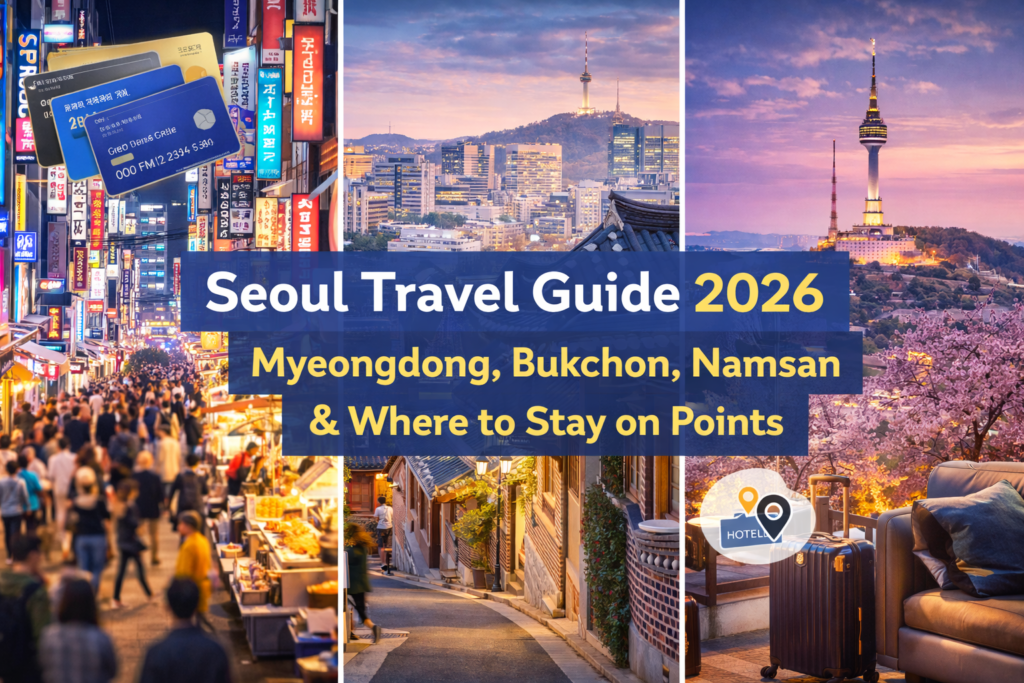
Seoul Travel Guide 2026: Myeongdong, Bukchon, Namsan & Where to Stay on Points
🛫 Planning your Seoul trip? 🏨 Book hotels with Agoda | 📱 Stay connected with Airalo (10% off) | 🎟️ Book tours & activities on Klook
📸 Follow our journey: Instagram @angeandzee | TikTok @angeandzee
Seoul was our final destination on a 100-day Asia trip — the last city before the flight home to Vancouver — and it received us with exactly the right energy for that moment. Confident, beautiful, endlessly walkable, and infused with the particular Korean brand of urban excellence that makes Seoul one of the most liveable major cities in the world.
We spent five nights based in Myeongdong at The Plaza Seoul, Autograph Collection — booked entirely on Marriott Bonvoy points — and used every day to explore a city that rewards attention at every level. Street food and department store food halls. Ancient palaces and futuristic architecture. Traditional hanok villages tucked between modern towers. A river running through the middle of it all, lined with parks where the city comes to breathe.
This is our complete Seoul travel guide — everything we did, everything we ate, and everything you need to know before you go.
Why Seoul Belongs on Every Asia Itinerary
Seoul is one of those cities that people underestimate before visiting and can’t stop talking about after. It sits in the shadow of Tokyo in most Western travellers’ Northeast Asia planning — slightly less famous, slightly less documented — and that relative underestimation makes it all the more rewarding when you arrive.
The city is extraordinarily well designed at every scale — from the sweep of its major boulevards to the intimate detail of its café interiors. It is one of the world’s great food cities, covering every register from $1 convenience store kimbap to multi-course tasting menus. It has more history than a five-day visit can absorb and a contemporary cultural energy — K-pop, K-beauty, K-drama, K-everything — that has made it one of the most culturally influential cities on earth.
And it is, by the standards of major Asian cities, very easy to navigate — a comprehensive subway system, widespread English signage, and a population that is genuinely helpful to lost tourists.
Getting to Seoul
By air: Seoul is served by two international airports — Incheon International (ICN), one of the world’s best airports, handles most international flights. Gimpo (GMP) handles domestic Korean flights and some short-haul international routes.
From Incheon: The AREX Airport Express runs directly to Seoul Station in approximately 43 minutes — clean, fast, affordable, and the obvious choice over taxis for most travellers. A T-money transit card handles the fare seamlessly.
From Canada: Air Canada flies direct from Vancouver and Toronto to Incheon. Korean Air — bookable on Alaska Mileage Plan points — operates the Vancouver to Seoul route. We flew the return leg on Korean Air economy and found it smooth and on time. Read our Korean Air ICN to YVR review for the full experience.
Getting Around Seoul
Seoul’s subway system is one of the best in the world — comprehensive, clean, affordable, colour-coded, and fully bilingual in Korean and English. A T-money card (purchased at any convenience store or subway station) handles all subway and bus fares and makes navigating the city entirely frictionless.
Kakao T is Korea’s ride-hailing app — the local equivalent of Grab — useful for point-to-point trips outside convenient subway range or late-night returns when walking isn’t appealing.
Walking is excellent throughout central Seoul — Myeongdong, Bukchon, Insadong, and the palace districts are all walkable from each other in ways that make exploring on foot one of the most rewarding ways to experience the city.
Where to Stay: The Plaza Seoul, Autograph Collection
We based our entire Seoul stay at The Plaza Seoul, Autograph Collection — a landmark hotel adjacent to Myeongdong, booked on Marriott Bonvoy points for five nights.
The hotel delivered beautiful classic Korean design, spacious and well-appointed rooms, and English-speaking staff throughout. The executive lounge was accessible through our Platinum Elite status — a useful evening retreat across five nights — with the one caveat that Platinum breakfast is served in the lounge rather than the main restaurant, which was a more limited experience than the Platinum benefit typically provides at comparable Marriott properties.
The location — steps from Myeongdong walking street, walkable to major attractions, well connected to the subway — was the hotel’s strongest asset and made it the right base for five days of serious Seoul exploration.
Read our full Plaza Seoul Autograph Collection review for the complete breakdown. Check current cash rates on Agoda or book through the Marriott portal for points redemptions.
The Best Things to Do in Seoul
Myeongdong — Street Food, Shopping and Pure Urban Energy
Myeongdong is Seoul’s most famous shopping and street food district and the neighbourhood we explored most thoroughly across our five nights — partly because it was on our doorstep and partly because it genuinely never got repetitive.
The pedestrian streets of Myeongdong come alive from mid-afternoon and peak in the evening — food vendors setting up stalls selling tteokbokki, hotteok, Korean corn dogs, egg bread, and dozens of other snacks; K-beauty shops offering samples with the particular enthusiasm of Seoul’s cosmetics retail culture; department stores lit up and busy well past 10pm.
What to eat in Myeongdong:
- Tteokbokki — spicy rice cakes in gochujang sauce, a Korean street food fundamental
- Hotteok — sweet filled pancakes, crispy outside and gooey inside, best eaten immediately
- Korean corn dogs — battered sausages on sticks with cheese, coated in panko or potato cubes
- Egg bread (gyeran-ppang) — warm oval bread with a whole egg baked inside, simple and extraordinary
- Bingsu — Korean shaved ice dessert, available from cafés throughout the district in flavours from strawberry to black sesame
Lotte Department Store food hall — the basement food hall of Lotte’s flagship Myeongdong store is worth visiting specifically and repeatedly. Premium Korean ingredients, prepared foods, international brands, and the best-curated food retail environment in the neighbourhood.
Bukchon Hanok Village — Ancient Seoul in Modern Context
Bukchon Hanok Village is one of Seoul’s most visited and most photographed neighbourhoods — a hillside area of preserved traditional Korean courtyard houses (hanok) dating from the Joseon dynasty, sitting between Gyeongbokgung Palace and Changdeokgung Palace in the heart of the city.
Walking through Bukchon’s narrow alleyways — stone walls, curved tile roofs, wooden gates, the occasional glimpse into a courtyard — is one of the most atmospheric experiences Seoul offers. The contrast between these centuries-old streets and the modern city visible in every direction creates a particular Seoul-specific feeling of time existing in layers rather than sequence.
Practical notes: Bukchon is most atmospheric early morning (before 10am) when tourist numbers are lower and the neighbourhood has its own quiet rhythm. Many of the hanok are private residences — signs throughout the area ask visitors to keep noise down and respect the people who still live there. The hill is steep in places; comfortable shoes are essential.
Getting there: Anguk subway station (Line 3) puts you at the base of Bukchon within a short walk.
Namsan Tower — Seoul From Above
N Seoul Tower, sitting atop Namsan Mountain at 480 metres above sea level, offers one of the best panoramic views of the city — the Han River visible to the south, the palace districts to the north, and the full scale of Seoul’s urban sprawl extending in every direction.
The tower itself is a tourist attraction with an observation deck, restaurants, and the famous love lock installations where couples attach padlocks to the fence railings. The view is the primary draw — particularly at dusk when the city transitions from daylight to the spectacular Seoul night skyline.
Getting there: Cable car from the base of Namsan Mountain (near Myeongdong) or a walking trail for the more energetic. The cable car queue can be long during peak times — arrive early or allow time.
Book tickets in advance through Klook to skip the queue.
Han River Parks — Seoul at Its Most Relaxed
The Han River runs through the centre of Seoul and its banks have been developed into a network of parks — Yeouido Hangang Park being the most popular — that function as the city’s collective outdoor living room. Locals come to cycle, picnic, play sport, fly kites, and simply be outside in a way that the density of the city’s urban core doesn’t always permit.
We spent time at the Han River parks and found them one of the most unexpectedly enjoyable Seoul experiences — the contrast between the city’s relentless energy and the calm of sitting by a wide river watching the city exist from a comfortable distance. Convenience stores along the riverbank sell everything needed for a riverside picnic: kimbap, fried chicken, instant noodles, beer, and the full range of Korean snack culture.
The chicken and beer (chimaek) culture — eating Korean fried chicken with cold beer by the Han River is a Seoul institution. Order through delivery apps or from riverside vendors, find a grass spot, and experience one of the city’s most authentically local pleasures.
Dongdaemun Design Plaza (DDP) — Architecture as Experience
The Dongdaemun Design Plaza is one of Seoul’s most architecturally striking landmarks — a vast, curvilinear building designed by Zaha Hadid that seems to defy conventional structural logic, its smooth aluminium skin flowing across the Dongdaemun district in a shape that looks simultaneously like a spaceship and a cresting wave.
The DDP functions as a design and culture hub — hosting exhibitions, fashion shows, markets, and events throughout the year. The building itself is worth visiting regardless of what’s on inside: walking around and through it at night, when the exterior lighting transforms the aluminium curves into something otherworldly, is one of Seoul’s most visually spectacular experiences.
The surrounding Dongdaemun district is also home to Seoul’s fashion wholesale market — a sprawling complex of buildings selling clothing, fabric, and accessories that operates largely overnight, reaching its peak activity between midnight and 5am when buyers from across Korea and Asia come to stock their shops.
Where to Eat in Seoul Beyond Myeongdong
Korean BBQ
Seoul’s Korean BBQ scene is among the best in the world — not the Korean BBQ of overseas Korean restaurants, but the real thing: quality meat, proper charcoal grills, an array of banchan (side dishes) that arrive automatically, and the communal pleasure of cooking together at the table.
The Myeongdong and Insadong areas have numerous well-regarded BBQ restaurants. For galbi (short ribs) and samgyeopsal (pork belly), look for restaurants where the grills are charcoal rather than gas and the meat quality is visibly good. Prices vary significantly — budget options exist alongside premium restaurants — and both ends of the spectrum are worth exploring.
Convenience Store Food
This deserves its own section because Seoul’s convenience stores — GS25, CU, 7-Eleven — are genuine food destinations that should not be dismissed. Freshly made kimbap rolls, instant ramyeon prepared in store, steamed buns, triangle gimbap, and an extraordinary range of prepared foods available 24 hours make convenience stores a legitimate meal option at any hour.
The egg salad sandwiches from Korean convenience stores have an international reputation. The instant noodles prepared with the in-store hot water dispensers are vastly better than their packaging suggests. The banana milk is a specific pleasure.
Insadong for Traditional Korean Food
The Insadong neighbourhood — a short walk or subway ride from Myeongdong — is one of Seoul’s most characterful areas for traditional Korean food, crafts, and the particular atmosphere of a neighbourhood that has deliberately preserved its older identity against the pressure of modernisation.
The alleyways running off Insadong’s main street contain small restaurants serving traditional Korean dishes, tea houses serving Korean traditional teas, and street food vendors selling traditional sweets and snacks that have been made the same way for generations.
Practical Information
Currency: South Korean Won (KRW). Cards are widely accepted throughout Seoul but carry some cash for markets and smaller vendors. ATMs are plentiful.
Language: Korean. English is widespread in tourist areas, hotels, and the subway system. Translation apps are useful for menus in local restaurants outside tourist districts.
Connectivity: South Korea has some of the fastest mobile internet in the world. Set up a South Korea e-SIM through Airalo before arrival — use our link for 10% off. Coverage is seamless throughout the city including the subway.
Weather: Seoul has four distinct seasons. Spring (April–May) and autumn (September–October) are the most pleasant — mild temperatures and the cherry blossom and autumn foliage respectively. Summer is hot and humid with a monsoon season in July–August. Winter is cold and dry with occasional snow.
Tipping: Not customary in South Korea — tipping can actually cause confusion in some contexts. Service is included and the culture doesn’t have a tipping tradition.
Getting around: T-money card for all subway and bus travel. Kakao T for ride-hailing. Walking for central neighbourhoods.
Seoul 5-Day Itinerary
Day 1 — Arrive, Myeongdong evening Arrive at Incheon, AREX to Seoul Station, check in to hotel. Evening in Myeongdong — street food, explore the walking street, Lotte Department Store food hall.
Day 2 — Palaces and Bukchon Morning at Gyeongbokgung Palace (arrive early). Walk to Bukchon Hanok Village for mid-morning. Insadong for lunch and traditional Korean food. Afternoon at Changdeokgung and the Secret Garden.
Day 3 — Namsan and Han River Morning at Namsan Tower (go early for clearest views). Afternoon at Han River parks — chimaek by the river. Evening in Hongdae for Seoul’s younger, more creative neighbourhood energy.
Day 4 — Dongdaemun and Shopping Dongdaemun Design Plaza in the afternoon (stunning at dusk). Evening exploring the Dongdaemun fashion district. Korean BBQ dinner.
Day 5 — Slow Myeongdong morning, depart Final morning in Myeongdong cafés. Last Korean convenience store exploration. AREX to Incheon for departure.
Frequently Asked Questions
How many days do you need in Seoul? Five nights is a comfortable amount for exploring the major neighbourhoods and attractions without rushing. Three nights is the minimum for a meaningful visit. A week would allow deeper exploration of areas like Hongdae, Gangnam, and day trips outside the city.
Is Seoul expensive? Moderate by major city standards — significantly cheaper than Tokyo or Singapore, comparable to or slightly cheaper than Hong Kong. Street food and convenience store meals are very affordable; restaurants range from cheap to premium; hotels in central areas are moderately priced with good points redemption options.
What is the best area to stay in Seoul? Myeongdong for walkability to major attractions and the best street food access. Hongdae for a younger, more creative atmosphere. Gangnam for business travel and the southern Seoul experience. For a first visit, Myeongdong or the adjacent City Hall area offers the best combination of location and convenience.
Is Seoul safe? Very — Seoul consistently ranks among the safest major cities in the world. Solo travellers, couples, and families all navigate the city comfortably at any hour.
What is the best way to get from Incheon Airport to Seoul? The AREX Airport Express to Seoul Station — 43 minutes, affordable, reliable. From Seoul Station, connect to any subway line for your specific destination.
Final Thoughts
Seoul was the perfect final destination for our 100-day Asia trip — a city confident enough in its own excellence to let you move through it at whatever pace you need, generous enough to reward every level of attention from casual wandering to deliberate exploration.
Myeongdong gave us five evenings of street food and energy that never felt repetitive. Bukchon showed us the Seoul that existed long before the towers went up. Namsan gave us the city from above. The Han River gave us the city at rest. And The Plaza Seoul, on Marriott Bonvoy points, gave us the right home base for all of it.
If you haven’t been to Seoul — go. If you’ve been and you’re thinking about going back — go sooner than you’re planning.
Check hotel availability on Agoda and book tours and activities through Klook.
For our full Plaza Seoul hotel review, read The Plaza Seoul Autograph Collection Review. For our complete 100-day Asia trip, start at our Asia trip overview.
Follow our journey: Instagram @angeandzee | TikTok @angeandzee