
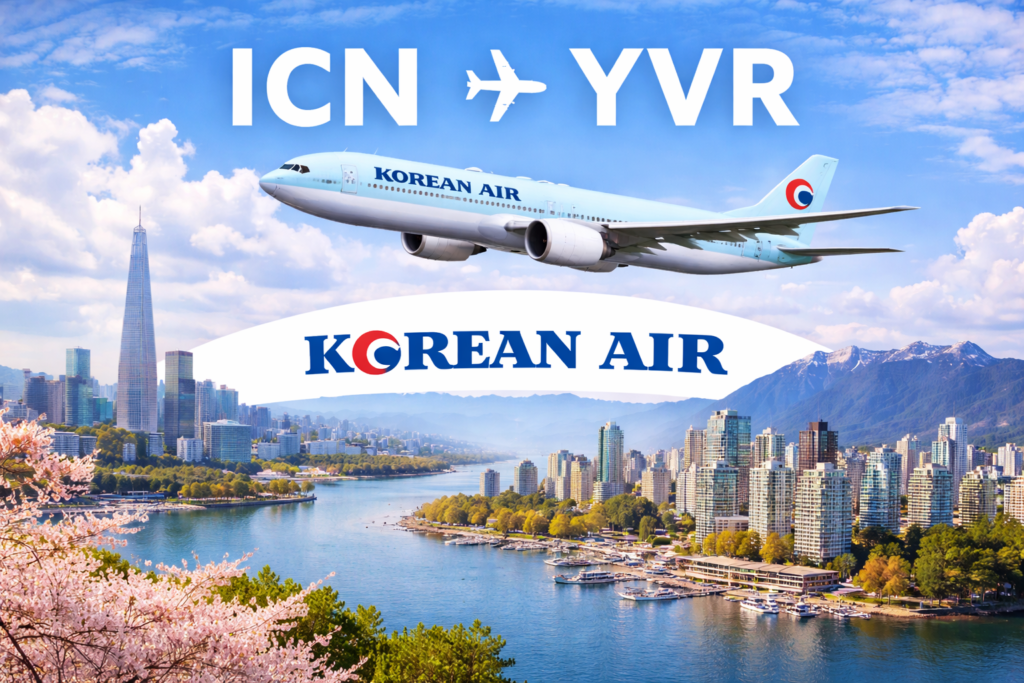
Korean Air Economy Review: Seoul ICN to Vancouver YVR on Alaska Mileage Plan Points
🛫 Planning a similar trip? 🏨 Book hotels with Agoda | 📱 Stay connected with Airalo (10% off) | 🎟️ Book tours & activities on Klook
📸 Follow our journey: Instagram @angeandzee | TikTok @angeandzee
Every trip ends with a flight home. After 100 days across Vietnam, Taiwan, Hong Kong, China, and South Korea — after the Great Wall and Lan Ha Bay and Da Nang’s beaches and Seoul’s Myeongdong street food and everything in between — ours ended on Korean Air flight from Seoul Incheon (ICN) to Vancouver (YVR).
We booked it on Alaska Mileage Plan points. It was smooth, on time, and honest in the way that most long-haul economy flights are honest — functional, adequate, doing exactly what it promises without particularly exceeding it. The meal was average. The seats were comfortable enough. The service was fine.
And it was bittersweet in a way that had nothing to do with Korean Air and everything to do with what landing in Vancouver meant.
Here’s the full review.
The Booking: Alaska Mileage Plan Points on Korean Air
Korean Air is a SkyTeam alliance member, and Alaska Airlines — despite being an Oneworld carrier — maintains a unique independent partnership with Korean Air through its Mileage Plan program that makes Korean Air flights bookable on Alaska miles. This is one of the more useful cross-alliance redemption opportunities available to North American points collectors and worth knowing about specifically.
Alaska Mileage Plan is earned through Alaska Airlines flights, the Bank of America Alaska Airlines Visa card, and various retail and travel partners. For Canadians and Americans with Alaska miles looking for transpacific flight options, the Korean Air partnership opens up a strong carrier on the Seoul to North American West Coast routing at competitive mileage rates.
The Seoul to Vancouver route on Korean Air is a logical and efficient transpacific connection — under 10 hours, direct, and operated by Korean Air’s well-maintained fleet. For the final leg of a 100-day Asia trip ending in Vancouver, it was the natural choice and the Alaska miles redemption made it an excellent one.
For our complete flight and points strategy across the full trip, read our how we saved $20,000 guide.
Incheon Airport: A World-Class Departure Experience
Before the flight itself, a brief note on Seoul Incheon International Airport — because it deserves one.
Incheon consistently ranks among the best airports in the world and the experience of departing from it reflects that reputation completely. Clean, spacious, efficient, and genuinely well designed — the kind of airport where the process of getting through check-in, security, and immigration feels almost pleasant rather than merely tolerable.
The terminal is large enough to have genuine variety in food and retail options, including Korean food stalls in the departure area that gave us one final opportunity to eat well in Korea before boarding. We took it. The departures hall at Incheon, with its Korean cultural displays and the particular atmosphere of a world-class hub airport in full operation, was a fitting final chapter of the Asia portion of the journey before the doors closed and we pointed east toward home.
The Seat: Comfortable Enough for Economy
Korean Air’s economy class on the ICN to YVR route delivered what competent long-haul economy delivers — comfortable seats with average legroom that serve their purpose without generating either complaints or compliments.
The seats themselves were comfortable — decent padding, reasonable recline, and a configuration that didn’t feel punishing for a sub-10-hour flight. The legroom was standard economy — not generous, not painful, the particular middle ground that economy passengers on transpacific routes have come to calibrate their expectations around.
For context: after 100 days of varied travel across Asia including some genuinely cramped domestic flights on budget carriers, Korean Air’s economy product felt perfectly adequate. Clean, well maintained, and without the sense of neglect that occasionally characterises older long-haul economy cabins on carriers that have deprioritised their economy product.
If you’re tall or particularly legroom-sensitive, the standard booking advice applies — check SeatGuru for the ICN-YVR aircraft configuration and choose accordingly. Korean Air offers seat selection on most fare types and the extra exit row cost is worth considering on a 10-hour overnight or long-haul flight.
The Food: Average, Honest Assessment
The meal service on Korean Air ICN to YVR was average — adequate, forgettable, and exactly representative of what mainstream long-haul economy catering delivers in 2025.
Korean Air typically offers a Korean food option alongside a Western alternative on transpacific routes, which is one of the more thoughtful aspects of their economy food offering — the Korean option is usually the stronger of the two and reflects the carrier’s pride in its national cuisine. The meal covered the basics without delivering anything that warranted a second thought once the tray was cleared.
For a flight home at the end of 100 days during which we had eaten extraordinarily well across eight countries — egg coffee in Saigon, sashimi ordered two days in advance in Hong Kong, Peking duck in Beijing, Korean BBQ in Myeongdong — economy airline food was always going to struggle for relevance. We ate, we appreciated that it was included, and we moved on.
This is not a criticism of Korean Air specifically — it’s a reflection of the category. Economy catering on long-haul transpacific flights operates within structural constraints that limit what any carrier can deliver. Korean Air operates competently within those constraints.
The Service: Smooth, Professional, On Time
The flight attendants on our Korean Air flight were professional and attentive in the understated way that characterises Korean service culture broadly — present when needed, efficient without being impersonal, and consistent throughout the flight without any memorable lapse or standout moment in either direction.
The flight departed on time from Incheon and arrived on schedule into Vancouver — a detail that matters more than it might seem on a final flight home after a long trip when the alternative (delays, rebooking, extended time in an airport on the wrong side of the world from your own bed) would have been genuinely unwelcome.
On time performance is the single most important metric for any flight, and Korean Air delivered it cleanly. After months of travel across Asia involving buses, trains, ferries, and more flights than we’ve counted, a smooth, uneventful flight home felt like exactly the right note on which to end.
The Bittersweet Part
We should be honest about the emotional register of this flight because it coloured the entire experience in a way that no review framework quite captures.
This was the last flight of 100 days. The last time we’d board a plane and arrive somewhere new. The last time for a long time that the world outside our window would be Asia — its coastlines giving way to the Pacific, the Pacific giving way to the familiar outlines of the British Columbia coast.
We watched the map on the entertainment screen more than we usually do on flights. We talked about the trip — not comprehensively, not wrapping it up neatly, but in the fragmented, non-linear way that the end of something significant produces. This moment from Vietnam. That meal in Beijing. The look on Zee’s face standing at Tiananmen Square for the first time in 20 years.
Korean Air provided a perfectly good vehicle for all of that. Smooth air, comfortable enough seats, the lights of Vancouver eventually appearing through the descent. It didn’t need to be a spectacular flight. It needed to get us home gently and on time.
It did exactly that.
Alaska Mileage Plan and Korean Air: Is It Worth It?
For Canadian and American travellers with Alaska Mileage Plan miles looking for Seoul to Vancouver redemptions, the Korean Air partnership delivers solid value — particularly for economy class where the mileage requirement is reasonable and the cash fare comparison is favourable.
Alaska Mileage Plan is not the most prominent program in the Canadian points ecosystem but it’s worth maintaining a balance if you fly Alaska Airlines or have the Bank of America Alaska card. The cross-alliance Korean Air partnership is exactly the kind of redemption opportunity that makes program diversification valuable — a useful transpacific option that Aeroplan and other Canadian-facing programs don’t replicate in quite the same way.
Key Alaska Mileage Plan and Korean Air tips:
- Book early — Korean Air award space on popular transpacific routes, particularly in premium cabins, fills quickly
- The ICN to YVR route is one of the most direct Seoul to Canada connections available — direct, under 10 hours, operated by Korean Air’s mainline fleet
- Economy redemption rates on Korean Air through Alaska are competitive — check current mileage charts before booking as rates can change
Korean Air Economy ICN to YVR: Quick Verdict
Seats: Comfortable, average legroom — fine for under 10 hours Food: Average — Korean option is the stronger choice if offered Service: Professional, attentive, consistent Punctuality: On time departure and arrival Booking: Alaska Mileage Plan — solid transpacific redemption value Overall: A competent, reliable economy product on a well-operated carrier. Not the most memorable flight of the trip — but the right one to bring us home.
Practical Information
Route: Seoul Incheon (ICN) to Vancouver International (YVR) Duration: Under 10 hours Alliance: SkyTeam — bookable on Alaska Mileage Plan through independent partnership Booking: Alaska Mileage Plan miles for the best points value. Check cash fares on Google Flights for cash rate comparison before redeeming Incheon Airport tips: Allow 3 hours before departure — the airport is large and immigration queues can build at peak times. Eat in the departures terminal — the Korean food options before your gate are excellent and significantly better than anything on board Vancouver arrival: YVR is efficient and well designed — Canadian citizens and permanent residents use the eGate system for customs and immigration, which moves quickly. NEXUS card holders have the fastest processing Connectivity for the flight: Download offline content before boarding — Korean Air’s WiFi is available but can be inconsistent on transpacific routes
Frequently Asked Questions
Can you book Korean Air on Alaska Mileage Plan? Yes — Korean Air is bookable through Alaska Mileage Plan despite Korean Air being SkyTeam and Alaska being Oneworld. The two carriers maintain an independent partnership that makes this cross-alliance redemption possible. It’s one of the more useful transpacific redemption options for North American points collectors.
Is Korean Air economy good? Korean Air economy is a solid, competent long-haul product — comfortable seats, reasonable service, and reliable on-time performance. It sits above budget carrier standards and delivers what you’d expect from a full-service Asian carrier without being among the top-ranked economy products in Asia. For a transpacific route the product is appropriate for the journey length.
How long is the Seoul to Vancouver flight? Under 10 hours direct — one of the shorter transpacific routes from Asia to Western Canada, which makes Korean Air’s ICN-YVR service particularly appealing for minimising total travel time on the return journey.
Is Incheon Airport good for layovers or departures? Excellent — Incheon consistently ranks among the world’s best airports and the experience of departing from it is genuinely good. Clean, efficient, well designed, and with strong food and retail options throughout the terminal.
How many Alaska miles does Seoul to Vancouver cost? Mileage requirements change — check the Alaska Mileage Plan award chart or search directly on the Alaska Airlines website for current ICN-YVR award pricing. Economy transpacific rates are generally competitive relative to the cash fare value.
Final Thoughts
Korean Air brought us home smoothly, on time, and without drama — which is precisely what you want from the final flight of a 100-day trip. The seats were comfortable enough. The food was average. The service was professional. The flight was on time.
And somewhere over the Pacific, watching the map inch eastward toward Vancouver, we sat with the particular feeling of something significant ending — grateful, a little sad, and already half-planning the next one.
The Alaska miles did their job. Korean Air did its job. And 100 days of Asia became something we carry with us rather than something we’re still in.
That’s the best possible ending.
For everything that went into this trip — the hotels, the flights, the points strategy, the lessons learned — start with our 100-day Asia trip overview and our how we saved $20,000 guide.
Follow along for the next adventure: Instagram @angeandzee | TikTok @angeandzee