
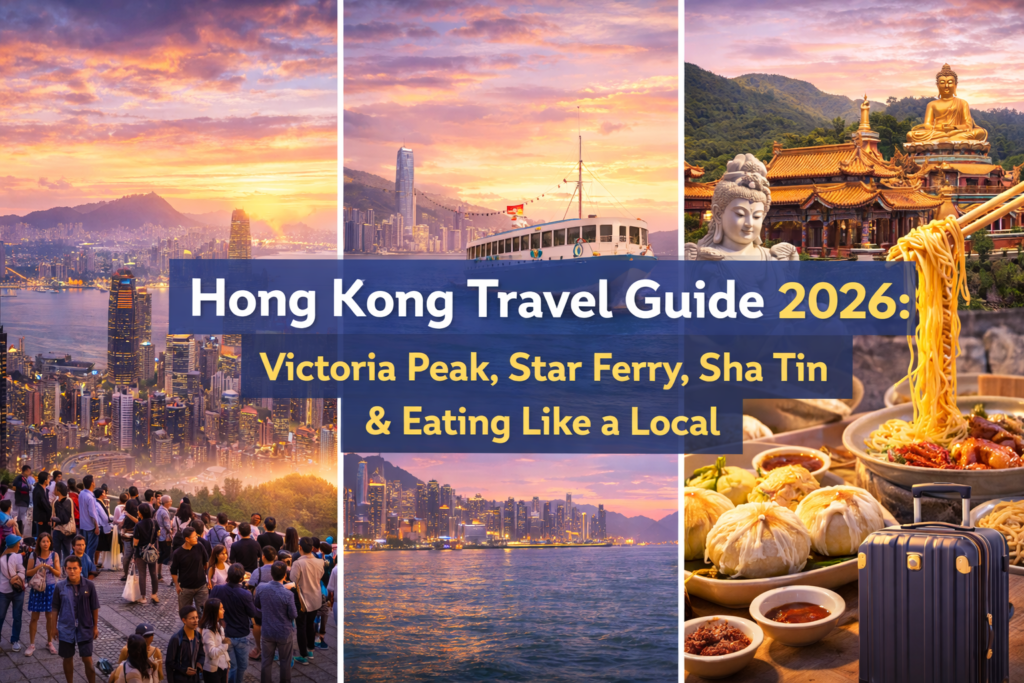
Hong Kong Travel Guide 2026: Victoria Peak, Star Ferry, Sha Tin & Eating Like a Local
🛫 Planning your Hong Kong trip? 🏨 Book hotels with Agoda | 📱 Stay connected with Airalo (10% off) | 🎟️ Book tours & activities on Klook
📸 Follow our journey: Instagram @angeandzee | TikTok @angeandzee
Hong Kong was not just a stop on our 100-day Asia trip. It was a homecoming.
Ange’s family is here — and visiting Hong Kong through the lens of family rather than tourism produces a completely different city from the one in the guidebooks. Not a worse version or a better one, but a more layered one — the tourist Hong Kong of Victoria Peak and the Star Ferry running in parallel with the local Hong Kong of Sha Tin’s neighbourhood restaurants, pre-ordered sashimi at a family’s regular spot, and afternoons at the racecourse that felt nothing like a tourist activity and everything like belonging somewhere.
We stayed across four properties — the Alva Hotel in Sha Tin, the Hyatt Regency Sha Tin, the JW Marriott Hong Kong, and with family — and used every day to move between the city’s registers. The famous and the familiar. The spectacular and the specific. The Hong Kong everyone comes to see and the Hong Kong that takes years of return visits and a family connection to find.
This is our complete Hong Kong travel guide — covering both sides of the city, written for travellers who want more than the highlights reel.
Why Hong Kong Remains One of Asia’s Greatest Cities
Hong Kong is a city that has been written off repeatedly and refused to cooperate with the obituaries. It has a density of experience — food, culture, landscape, urban spectacle, history — that few cities of any size match, compressed into a territory that you can cross end to end in under an hour on the MTR.
The skyline is one of the world’s most dramatic, rising from a harbour that gives it a stage no landlocked city can replicate. The food culture is among the finest in Asia — a synthesis of Cantonese tradition, international influence, and the particular Hong Kong obsession with eating well that permeates every level of the city from Michelin-starred restaurants to $3 wonton noodle shops. The transport infrastructure is world-class. The shopping is extraordinary. And the contrast between the density of the urban core and the green hills and beaches of the outlying territories creates a city of geographical variety that surprises almost every first-time visitor.
Hong Kong rewards return visits in a way that few destinations do — each trip revealing layers that the previous one didn’t reach. Having family here accelerated that process dramatically for us.
Getting to Hong Kong
By air: Hong Kong International Airport (HKG) on Lantau Island is one of the world’s busiest and best-connected airports — served by virtually every major carrier and well positioned as an Asia hub for connections across the region.
From Canada: Cathay Pacific flies direct from Vancouver and Toronto to Hong Kong — bookable on Cathay Asia Miles for strong transpacific value. Air Canada and other carriers operate the route with connections. British Airways Avios (earned through RBC Avion in Canada) can also be used for Cathay Pacific bookings through the oneworld partnership.
From the airport: The Airport Express train connects HKG to Hong Kong Station in the city in 24 minutes — the fastest and most reliable option. Taxis are available but significantly slower and more expensive. The Airport Express also stops at Tsing Yi and Kowloon stations for travellers staying on the Kowloon side.
Getting Around Hong Kong
The MTR is the foundation of Hong Kong movement — one of the world’s most efficient urban rail systems, clean, air-conditioned, punctual, and covering Hong Kong Island, Kowloon, the New Territories, and connections to the airport in a comprehensive network.
Octopus card — Hong Kong’s contactless payment card, used for MTR, buses, trams, ferries, and accepted at convenience stores, fast food restaurants, and many retail outlets throughout the city. Purchase at any MTR station on arrival and top up as needed. Essential for any Hong Kong visit of more than a few hours.
The trams — Hong Kong Island’s historic double-decker trams run along the northern corridor from Kennedy Town to Shau Kei Wan, accepting Octopus card payment. Slow by MTR standards but one of the most atmospheric ways to move through the city and a genuine Hong Kong experience in themselves.
Star Ferry — the iconic cross-harbour ferry connecting Tsim Sha Tsui in Kowloon with Central and Wan Chai on Hong Kong Island. More than a transport option — one of the world’s great harbour crossings, with one of the world’s great urban skylines as the view.
Grab — available in Hong Kong for ride-hailing, useful for point-to-point trips outside convenient MTR range.
Where to Stay in Hong Kong on Points
We stayed across multiple properties during our Hong Kong visit — a deliberate strategy that allowed us to experience different neighbourhoods and extract maximum value from our points and certificates across a longer stay.
Alva Hotel Sha Tin — Best Value Cash Stay
At $100–$150 USD per night, the Alva delivered excellent value in a convenient Sha Tin location — close to the MTR, New Town Plaza, and the local restaurants that family took us to. Comfortable beds, great location, and the neighbourhood feel of Sha Tin rather than the tourist intensity of central Hong Kong. Read our Alva Hotel Sha Tin review. Check rates on Agoda.
Hyatt Regency Sha Tin — Best Free Night Certificate
We used a World of Hyatt free night certificate here — saving $300 USD on the cash rate — for one excellent night in modern, spacious rooms with nice views and outstanding English-speaking service. The location within Sha Tin requires a short taxi or Grab from the MTR but the certificate value is exceptional during peak Hong Kong pricing. Read our Hyatt Sha Tin review.
JW Marriott Hong Kong — Best Lounge and Central Location
One deliberate night of luxury in the heart of Hong Kong on 85,000 Marriott Bonvoy points — outstanding evening hors d’oeuvres that were the best lounge experience of our entire Hong Kong stay, impeccable breakfast, and the buzzing urban energy of being in the middle of one of the world’s great cities. Rooms showed their age but the overall experience delivered. Read our JW Marriott Hong Kong review.
The Best Things to Do in Hong Kong
Victoria Peak — The View That Defines the City
Victoria Peak is Hong Kong’s most visited attraction for the simplest possible reason: the view from the top is one of the most spectacular urban panoramas on earth.
Standing on the Peak Terrace looking south over the harbour — the towers of Central and Wan Chai rising from the waterfront, Kowloon stretching beyond, the green hills of the New Territories visible in the distance — produces the specific feeling of a city revealing itself completely. You understand Hong Kong’s geography from up here in a way that moving through its streets doesn’t provide. The density, the harbour, the relationship between the urban core and the surrounding hills — it all becomes clear.
Getting there: The Peak Tram from Garden Road is the classic and most atmospheric ascent — a funicular railway that has been carrying passengers up the hill since 1888, steeply inclined enough that standing passengers grip the handrails and sitting passengers feel the angle in their spines. The queue can be significant during peak times — book tickets in advance through Klook to skip the line. Alternatively, Bus 15 from Central is slower and less atmospheric but queue-free.
Practical notes: The view is best on clear days — Hong Kong’s frequent haze can obscure the distance on humid days. Early morning and after rain tend to offer the clearest conditions. The Peak at night, with the city lights reflecting off the harbour, is equally spectacular and worth a separate visit if your schedule allows.
Star Ferry — Five Minutes, One of the World’s Great Journeys
The Star Ferry crossing between Tsim Sha Tsui and Central takes approximately five minutes and costs a few Hong Kong dollars on your Octopus card. It is one of the best value experiences in any city in the world.
The view from the middle of Victoria Harbour — Hong Kong Island’s skyline to the south, Kowloon’s dense urban landscape to the north, the harbour traffic of container ships, sampans, and tourist boats moving between them — is the iconic Hong Kong image that photographs can’t fully replicate. The ferry itself, with its green and white livery unchanged in essential character since the 1880s, is a piece of living history that the city has chosen to preserve rather than replace with something faster and less characterful.
Take it in both directions. Take it at dusk when the city is transitioning to its spectacular night mode. Take it more than once — it doesn’t get old.
Temple Street Night Market — Kowloon After Dark
Temple Street Night Market in Jordan, Kowloon, is one of Hong Kong’s most characterful evening experiences — a strip of stalls running through the neighbourhood from late afternoon until midnight, selling everything from clothing and electronics to jade jewellery, phone cases, and the accumulated miscellany of Hong Kong street commerce.
The market has a particular atmosphere — less polished than the tourist-facing shopping areas of Tsim Sha Tsui, more genuinely embedded in the daily life of a working-class Kowloon neighbourhood. Fortune tellers set up at the southern end. Outdoor restaurants on the surrounding streets serve seafood and Cantonese dishes to tables that spill onto the pavement.
What to look for: The market is best approached as an atmospheric wander rather than a serious shopping destination — prices are negotiable but the goods are tourist-facing. The pleasure is the environment: the noise, the compression of stalls, the cooking smells from the surrounding restaurants, and the specific energy of Kowloon at night.
Getting there: Jordan MTR station (Tsuen Wan Line), Exit A.
Ladies Market — Mong Kok’s Street Shopping
Ladies Market on Tung Choi Street in Mong Kok is Hong Kong’s most famous street market — a dense strip of stalls selling clothing, accessories, souvenirs, and tourist goods stretching along several blocks of one of Kowloon’s busiest shopping neighbourhoods.
The market itself is functional tourist shopping — not the place for authentic Hong Kong goods or genuine bargains, but worth walking through for the atmosphere and for the broader Mong Kok experience that surrounds it. The neighbourhood is one of the most densely populated urban areas in the world and has an energy proportional to that density — overwhelming and fascinating in equal measure.
Mong Kok street food — the eating around Ladies Market and throughout Mong Kok is better than the shopping. Fish balls on skewers, curry fish balls, stinky tofu, egg waffles (gai daan jai), and the full spectrum of Hong Kong street snacking culture are all available from vendors throughout the neighbourhood. Eat as you walk. Eat everything.
Eating Hong Kong: The Food Guide
Hong Kong’s food culture is one of the world’s great culinary traditions — Cantonese cooking at its finest, refined over generations in a city that takes the subject with absolute seriousness at every price point. These are the dishes and experiences that defined our visit.
Roast Goose — The Pinnacle of Hong Kong BBQ
Cantonese roast goose is one of the great dishes of Chinese cuisine and Hong Kong is where it reaches its highest expression — the skin lacquered to a deep mahogany, crackling and glossy; the meat rich and yielding underneath; served over rice with plum sauce. The best roast goose restaurants in Hong Kong have queues that form before opening and sell out before the lunch service ends.
Family took us to their regular roast goose restaurant in Sha Tin — the kind of neighbourhood place that doesn’t appear in travel guides but has been feeding the same families for decades. The goose was extraordinary. Sitting at a round table with family, sharing plates of roast meats and vegetables and rice, was one of the most genuinely pleasurable meals of the entire 100-day trip — not because of the setting or the prestige, but because of the company and the food and the specific feeling of being welcomed into someone’s regular life.
Char Siu BBQ Pork — Everywhere, Always Good
Char siu — Cantonese BBQ pork, lacquered with honey and five-spice and roasted until the exterior caramelises and the interior stays tender — is available throughout Hong Kong at every price point from market stalls to dedicated BBQ shops to roast meat restaurants, and it is almost universally good.
The specific pleasure of char siu in Hong Kong is its omnipresence — it is a city where you are never far from excellent BBQ pork, served over rice or in a bun or as a component of noodle soup. We ate it regularly throughout our stay and never encountered a version that disappointed.
Wonton Noodle Soup — Hong Kong’s Soul Food
Wonton noodle soup is Hong Kong’s most fundamental comfort food — tiny, delicate wontons filled with shrimp and pork, served in a clear broth with thin egg noodles that have a specific springy texture (achieved through a traditional bamboo-beating process) that distinguishes Hong Kong wonton noodles from every imitation.
A good bowl of wonton noodles in Hong Kong — at a neighbourhood noodle shop, at a plastic table, for less than $50 HKD — is one of the most satisfying eating experiences the city provides. Family’s regular noodle shop in Sha Tin served a version that made every subsequent wonton noodle elsewhere a slight disappointment by comparison.
Hong Kong Milk Tea — The City’s Daily Ritual
Hong Kong-style milk tea (港式奶茶) is made by pulling strongly brewed Ceylon tea through a silk stocking filter multiple times — a process that creates a smooth, intensely flavoured tea that is then combined with evaporated or condensed milk. The result is richer, stronger, and more complex than any standard milk tea and has been a cornerstone of Hong Kong café culture (cha chaan teng) since the mid-20th century.
The Red Tea Cafe in Sha Tin — a family recommendation — served the best version we encountered on the trip. Sitting in a neighbourhood cha chaan teng, drinking milk tea with pineapple buns fresh from the oven alongside family, is the specific Hong Kong experience that no tour itinerary can manufacture.
Pineapple Bun — The Essential Bakery Stop
The pineapple bun (菠蘿包) contains no pineapple — the name refers to the crackly, scored sugar crust on top that resembles the texture of a pineapple skin. The bun itself is soft and slightly sweet, best eaten warm from the oven, and transcendent when split and filled with a thick slice of cold butter that melts slowly against the warm bread.
Hong Kong’s bakeries produce pineapple buns throughout the day and the best are eaten within minutes of coming out of the oven. Finding a neighbourhood bakery with a queue of locals waiting for the morning batch is one of the most reliably excellent Hong Kong food experiences available to any visitor.
Egg Waffles — The Street Snack That Belongs to Hong Kong
Egg waffles (雞蛋仔, gai daan jai) are a Hong Kong invention — a street food specific to this city, made in a special bubble-patterned mould that produces a crispy outer shell encasing a soft, eggy interior in dozens of individual spheres. Eaten hot from the vendor’s cart, they are one of those simple, perfect street foods that resist all improvement.
Found throughout Hong Kong from Mong Kok street vendors to upmarket café interpretations, egg waffles are inescapable and worth eating at every opportunity.
Loi Fat Koon — The Sashimi You Book Two Days in Advance
Loi Fat Koon in Sha Tin is the restaurant that family pre-ordered sashimi from two days in advance — and the experience justified every minute of the planning. A neighbourhood seafood restaurant with no tourist presence and a local reputation built over decades, where the fish quality and freshness is genuine rather than performative.
Booking ahead and arriving to a table already prepared with excellent sashimi that family had selected specifically for the occasion was one of those meals that the best travel produces — not the most famous restaurant or the most Instagrammable setting, but the most right one for the moment.
This is the Hong Kong that visiting family unlocks. No guidebook will send you here. You need someone who knows.
The Local Hong Kong vs Tourist Hong Kong
This is the most important thing we can tell you about visiting Hong Kong: the city experienced through local knowledge is fundamentally different from the city experienced through a travel itinerary, and the gap between them is larger than in almost any other city we visited on the trip.
Tourist Hong Kong is spectacular — Victoria Peak, the Star Ferry, Temple Street, the harbour, the shopping, the hotel bars with their skyline views. All of it is worth doing and genuinely excellent.
Local Hong Kong — the neighbourhood restaurants where families have eaten for decades, the specific bakery that makes the best pineapple buns in Sha Tin on Tuesday mornings, the racecourse on a Saturday afternoon with $20 HKD bets and a crowd of genuine punters rather than tourists, the cha chaan teng where milk tea is made by someone who has been making it the same way for thirty years — is a different city running parallel to the one in the guidebooks.
If you have any connection to Hong Kong — family, friends, colleagues — use it. Ask them where they eat, not where they take visitors. The distinction will change your experience of the city completely.
If you don’t have a connection, our Hong Kong local experience guide covers the specific neighbourhood restaurants, racecourse tips, and local experiences from our family-guided stay in Sha Tin.
Hong Kong 5-Day Itinerary
Day 1 — Arrive, Kowloon evening Airport Express to city, check in. Evening in Tsim Sha Tsui — Star Ferry crossing, Kowloon waterfront promenade, dinner in a local Cantonese restaurant.
Day 2 — Hong Kong Island Victoria Peak morning (go early for clear views). Descend through the Mid-Levels to Central. Afternoon in Wan Chai and Causeway Bay. JW Marriott or another Central hotel lounge evening if you have status access.
Day 3 — Kowloon Local Temple Street Night Market evening. Ladies Market and Mong Kok street food afternoon. Egg waffles from a street vendor. Dim sum breakfast at a local restaurant.
Day 4 — Sha Tin and New Territories Sha Tin racecourse if timing allows (Wednesdays and weekends). Local restaurant lunch with whatever neighbourhood recommendation you’ve obtained. Afternoon exploring New Town Plaza and Sha Tin’s local restaurant streets.
Day 5 — Slow morning, depart Final pineapple bun from a local bakery. Last wonton noodle soup. Airport Express to HKG.
Practical Information
Currency: Hong Kong Dollar (HKD). Cards widely accepted throughout the city; Octopus card for all transit and convenience payments. ATMs plentiful.
Language: Cantonese is the primary language; English is widely spoken and all official signage is bilingual. One of the easiest Asian cities to navigate without local language skills.
Connectivity: Set up a Hong Kong e-SIM through Airalo before arrival — use our link for 10% off. Coverage is excellent throughout the city and MTR network.
Weather: Hong Kong has a subtropical climate. October to December is the most pleasant period — clear skies, low humidity, comfortable temperatures. January to March is cool. April to September is hot and humid with typhoon season from May to November.
Tipping: Not mandatory but appreciated at restaurants — 10% is standard where no service charge is included. Many restaurants add a 10% service charge automatically.
Getting around: Octopus card for everything. MTR for cross-city movement. Trams for atmospheric Hong Kong Island travel. Star Ferry for the harbour crossing experience. Grab for late nights and awkward connections.
Tours and activities: Book Victoria Peak tram tickets, day trips, and harbour cruises through Klook.
Frequently Asked Questions
How many days do you need in Hong Kong? Five days is ideal for covering the major attractions and having time for neighbourhood exploration. Three days is workable for a first visit focused on highlights. A week allows deeper exploration of the outlying islands, the New Territories, and the local Hong Kong that longer stays unlock.
Is Hong Kong expensive? Hong Kong is one of Asia’s more expensive destinations — hotel prices in particular are significant. Food ranges from very affordable (local restaurants, street food, cha chaan teng) to expensive (hotel restaurants, international dining). Using points for accommodation dramatically improves the value equation.
What is the best area to stay in Hong Kong? Central or Wan Chai on Hong Kong Island for easy access to the main tourist areas and nightlife. Tsim Sha Tsui in Kowloon for the waterfront views and shopping. Sha Tin in the New Territories for a local neighbourhood experience at lower hotel prices — our preferred base for combining family time with city exploration.
Is Hong Kong safe? Very — Hong Kong has consistently been one of Asia’s safest cities for visitors. Standard urban awareness applies but the city is genuinely safe for solo travellers, couples, and families.
What is the Star Ferry and is it worth it? The Star Ferry is a historic cross-harbour ferry running between Tsim Sha Tsui and Central — one of the world’s most iconic short journeys with one of the world’s best urban views. At a few HKD on your Octopus card, it is among the best value experiences in Hong Kong. Absolutely worth it.
Can you visit Hong Kong without speaking Cantonese? Completely — English is widely spoken and all signage is bilingual. Hong Kong is one of Asia’s most accessible cities for English-speaking visitors without local language skills.
Final Thoughts
Hong Kong gave us something that no other stop on our 100-day trip quite replicated — the layered experience of a world-class city seen through both tourist and local eyes simultaneously. The spectacular harbour and the neighbourhood noodle shop. Victoria Peak and the Sha Tin racecourse. The JW Marriott lounge and the cha chaan teng milk tea.
Visiting family shaped everything. They showed us a Hong Kong that runs parallel to the one in the guidebooks — quieter, more specific, more deeply satisfying in the way that the familiar always is. The pre-ordered sashimi at Loi Fat Koon. The best pineapple bun in Sha Tin on a Tuesday morning. The roast goose at a round family table that tasted better than anything that could have been planned.
Come to Hong Kong for the skyline and the Star Ferry and the dim sum. Stay long enough to find the other city underneath — the one that doesn’t need your visit to justify its existence and welcomes you into it anyway.
Check hotel availability on Agoda. For our individual hotel reviews, read the Alva Hotel Sha Tin review, Hyatt Sha Tin review, and JW Marriott Hong Kong review. For the full local experience story, read our Hong Kong local experience guide.
This was part of our 100-day Asia adventure.
Follow our journey: Instagram @angeandzee | TikTok @angeandzee