Walking the Camino de Santiago in 2026: Our Europe Travel Plans & Points Strategy
🛫 Planning a similar trip? 🏨 Book hotels with Agoda | 📱 Stay connected with Airalo (10% off) | 🎟️ Book tours & activities on Klook
📸 Follow our journey: Instagram @angeandzee | TikTok @angeandzee
We landed back in Vancouver at the end of 2025 with full hearts, tired legs, and the particular post-trip restlessness that sets in almost immediately after a long journey ends. One hundred days across Asia. Eight countries. Twenty-eight articles worth of memories. And somewhere over the Pacific on that final Korean Air flight home, we started talking about what comes next.
The answer came quickly, and it came in two parts.
First: walk the Camino de Santiago.
Then: reward ourselves with Europe.
This is the dream we’re building toward in 2026 — and this post is where we think out loud about what it looks like, how we’re planning to fund it, and why, after 100 days of temples and night markets and supertower hotels and hutong alleyways, a 800-kilometre walk across northern Spain feels like exactly the right next chapter.
Why the Camino de Santiago
There are trips you take because you want to see a place. And then there are trips you take because you need to become something — or find out if you can.
The Camino de Santiago is the second kind.
The Camino is one of the world’s most famous pilgrimage routes — a network of ancient paths across Europe that converge on the Cathedral of Santiago de Compostela in northwestern Spain, where tradition holds the remains of Saint James the Apostle are buried. Pilgrims have been walking it for over a thousand years. Today, hundreds of thousands of people from every country in the world walk some version of it every year — believers and non-believers, the physically fit and the quietly determined, the recently bereaved and the newly graduated and the couples who decided that 800 kilometres on foot together was a reasonable idea.
We are firmly in that last category.
The Camino Francés: The Classic Route
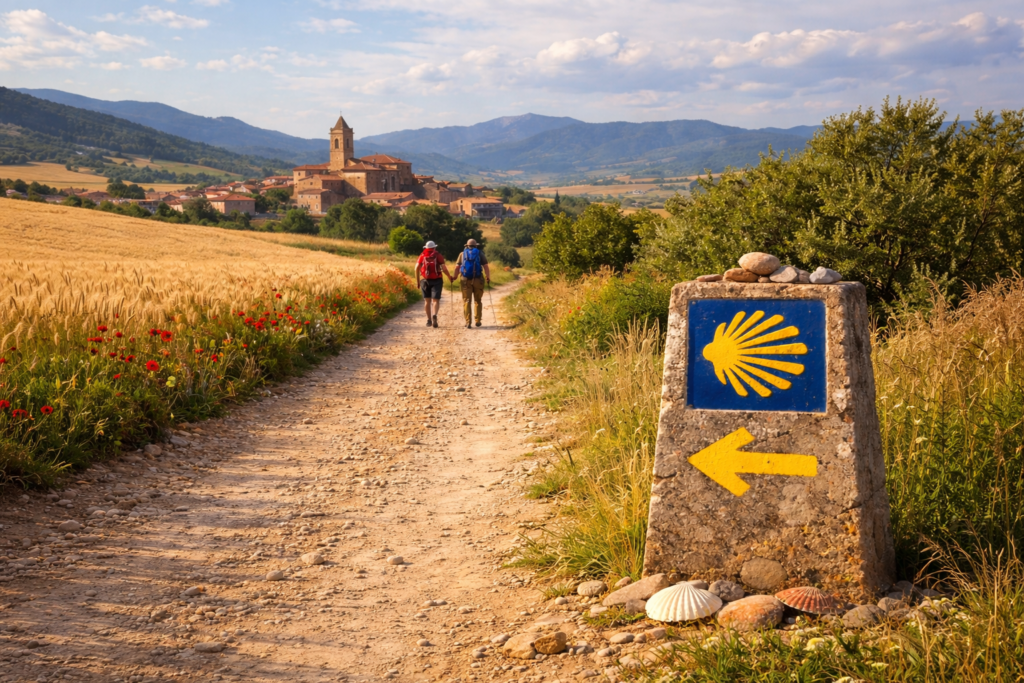
Of the many Camino routes — the Portugués from Lisbon, the Norte along Spain’s northern coast, the Primitivo through Asturias — we’ve settled on the Camino Francés: the classic route, the original pilgrimage road, the one that begins in Saint-Jean-Pied-de-Port in the French Pyrenees and walks 800 kilometres west across the breadth of northern Spain to Santiago de Compostela.
It takes most walkers 30 to 35 days. It crosses mountain passes, medieval cities, endless meseta plateau, river valleys, and the green hills of Galicia. It passes through Pamplona and Logroño and Burgos and León and a hundred smaller towns and villages that have been feeding and sheltering pilgrims for centuries. It ends at a cathedral square where, tradition dictates, you have earned something — what exactly, each person decides for themselves.
What Draws Us to It
The physical challenge is a genuine part of the appeal. Thirty-plus consecutive days of walking 20–25 kilometres — with a pack, through whatever weather northern Spain produces, on legs that will hurt in ways they’ve never hurt before — is a real undertaking that requires real preparation. We are not casual hikers. We will need to become more serious ones before Saint-Jean-Pied-de-Port.
The spiritual and reflective dimension matters to us too — not in a narrowly religious sense, but in the broader sense that a month of walking with nothing more complex to decide than how far to go today creates a quality of thinking and reflection that ordinary life systematically prevents. There is something about sustained physical effort in beautiful landscape, among strangers who are all doing the same thing for their own reasons, that produces a particular kind of clarity. We want that.
And then there is the simple fact that it combines travel and adventure in a way that no other experience quite does — not sightseeing, not relaxing, not exploring in the conventional tourist sense, but moving through a place slowly enough to actually feel it. After the speed of our Asia trip — eight countries in 100 days, always moving, always arriving somewhere new — the Camino’s deliberate, one-foot-in-front-of-the-other pace feels like the opposite and the complement.
Meeting People From Around the World
The Camino has its own community — the Camino family, as veterans of the walk call it. The people you meet on the first day in the Pyrenees will reappear throughout the journey, sometimes walking alongside you, sometimes overtaking you, sometimes falling behind, creating the particular web of connections that forms when strangers share a sustained, difficult experience.
We have heard from everyone who has walked it that the people are as much the point as the landscape. The retired teacher from Germany. The recent graduate from South Korea. The couple from Brazil walking it for their 25th anniversary. The solo walker from Australia who isn’t sure why they came but knows they needed to. These are the conversations that happen on the Camino and don’t happen anywhere else — honest in the particular way that exhaustion and shared purpose make people honest.
We are looking forward to those conversations enormously.
The Structure: Walk First, Then Reward Ourselves With Europe
This part of the plan felt obvious once we articulated it: walk the Camino first, then reward ourselves with European cities after.
The logic is both practical and psychological. Arriving in Europe and immediately spending weeks in Paris and Rome and Lisbon before the Camino would mean starting the walk with full tourist legs — the soft, comfortable legs of someone who has been eating well and sleeping in good hotels. The Camino would become harder, not easier, in that sequence.
More importantly — earning the cities by walking first feels right. Santiago de Compostela is the end of a month of genuine effort. What follows should feel like a reward, a celebration, a different mode of travel entirely. Arriving in Paris after 800 kilometres on foot is an entirely different experience from arriving in Paris off a transatlantic flight. We want that contrast. We want to sit in a Parisian café on legs that have walked across Spain and feel the specific satisfaction of that.
The Rough Itinerary
The current thinking — subject to all the flexibility that good travel planning requires — looks something like this:
Fly into Paris — a few days to adjust to Europe, absorb the city, eat extraordinarily well, and mentally prepare for what’s coming.
Train to Saint-Jean-Pied-de-Port — the traditional starting point of the Camino Francés, a small medieval town in the French Basque Country at the foot of the Pyrenees. Trains from Paris to Bayonne, then local connection to Saint-Jean. This is where the Camino begins.
Walk the Camino Francés — approximately 30 to 35 days, Saint-Jean-Pied-de-Port to Santiago de Compostela. One foot in front of the other, every day, until the cathedral appears.
Arrive in Santiago de Compostela — rest, recover, attend the Pilgrim’s Mass at the cathedral, collect the Compostela certificate, sit in the square and feel whatever it is you feel at the end of something like that.
Train onward through Spain and Portugal — post-Camino, the plan opens up into more conventional European travel. Spain has more to offer than the Camino corridor — we want time in cities we haven’t seen. Portugal is a country we’ve been wanting to visit for years. The train network connecting Spain and Portugal makes this routing natural and efficient.
Italy as the final chapter — Rome, Florence, the Cinque Terre, wherever the itinerary leads by the time we get there. Italy as the reward at the end of the reward, the final European flourish before the flight home.
Fly home from Rome or another European hub — completing a journey that will have moved us from the French Pyrenees to the Atlantic coast to the Mediterranean in one extended arc across southern Europe.
The Points Strategy: Funding Europe on Aeroplan and Avios
We funded our entire 100-day Asia trip on points accumulated over two to three years and saved over $20,000 CAD in the process. Europe will require a similar strategy — and in some ways a more targeted one, because the European travel ecosystem has specific program strengths that the Asia trip didn’t require us to use.
Getting There: Aeroplan for Transatlantic Flights
Aeroplan is our primary vehicle for the transatlantic flights — Vancouver to Paris and back from Rome — and we’re already building the balance we’ll need.
Aeroplan’s transatlantic sweet spots are well documented in the points community: Air Canada flights to Europe, and partner Star Alliance carriers including Lufthansa, Swiss, TAP Air Portugal, and others, are all bookable through Aeroplan at award rates that represent strong value relative to cash fares — particularly in business class, where Aeroplan’s fixed partner pricing can deliver extraordinary value on premium cabin transatlantic redemptions.
For a trip where the physical demands of the Camino make the outbound flight a genuine consideration — arriving rested in Paris before 800 kilometres of walking is a different proposition than arriving exhausted — the case for using Aeroplan points for a premium transatlantic cabin is compelling.
Getting Around: Avios for European Flights
British Airways Avios are our primary vehicle for intra-European flying, and the program’s distance-based pricing makes it particularly valuable for short European routes.
Avios calculates award pricing by distance rather than by zone, which means short hops between European cities — Paris to Madrid, Lisbon to Rome, any number of combinations across our itinerary — can be redeemed for very modest Avios amounts. A flight that costs a meaningful cash fare between European cities often requires only 4,000–8,000 Avios as an award, making the program extraordinarily efficient for the kind of city-hopping that post-Camino European travel involves.
We’re building our Avios balance through the RBC Avion card and everyday spending on Avios-earning partners, with the specific European routing in mind.
Trains: The Eurail and Point-to-Point Strategy
Europe’s train network is one of its greatest assets — fast, comfortable, scenic, and connecting cities in ways that often make trains preferable to flights even when price isn’t the primary consideration.
The journey from Paris to Saint-Jean-Pied-de-Port. The post-Camino routing through Spain and into Portugal. The connections between Portuguese and Italian cities. All of these are better by train than by plane — both for the experience and for the environmental consideration that an extended trip in Europe makes relevant in a way that Asia’s more dispersed geography didn’t.
We’re researching Eurail pass options alongside point-to-point booking strategies — the right approach depends on the specific itinerary as it solidifies, but trains will be a central part of how we move through Europe in a way they weren’t in Asia.
Hotels: Points Already Building
Our Marriott Bonvoy, Hilton Honors, and IHG One Rewards balances are all being rebuilt after the Asia trip, with Europe specifically in mind. The European luxury hotel landscape on points is exceptional — properties like the InterContinental Paris Le Grand, the JW Marriott Venice, and the Hilton Rome Cavalieri are all accessible on the programs we’re already accumulating in.
Post-Camino specifically, after 35 days of albergue accommodation and shared dormitories, arriving at a beautiful hotel in Santiago de Compostela or Lisbon on points will feel like the reward it’s designed to be.
What We’re Doing to Prepare
Physical Training
The Camino Francés is not a casual walk. The first stage alone — Saint-Jean-Pied-de-Port over the Pyrenees to Roncesvalles — is 25 kilometres with 1,400 metres of elevation gain, done on day one with a full pack. People drop out in the first week at a significant rate, usually due to blisters, knee problems, or the accumulated impact of daily distances their bodies weren’t prepared for.
We are taking the physical preparation seriously. Building a regular walking routine with increasing distances and elevation. Investing in properly fitted footwear — the single most important equipment decision on the Camino, where feet are everything. Developing the pack weight discipline that separates comfortable Camino walkers from suffering ones. Training our bodies for 30 consecutive days of 20–25 kilometre efforts in a way that our Asia trip, for all its walking, did not require.
We have time. We are using it.
Research and Reading
The Camino has a rich literature and we’re working through it. John Brierley’s guidebook is the standard practical reference — detailed stage-by-stage information, elevation profiles, accommodation listings, and the philosophical framing that has made it the pilgrim’s companion of choice for decades. Beyond the guidebook, the memoirs and reflections of people who have walked it — Shirley MacLaine’s The Camino, Paulo Coelho’s The Pilgrimage, and dozens of more recent accounts — are giving us the experiential context that practical guides don’t provide.
Points Accumulation
Both of us are accumulating hard. Every dollar of everyday spending is being directed through the cards that build the balances we need — Aeroplan through the TD Aeroplan Visa, Avios through the RBC Avion transfer pathway, Marriott through the Bonvoy card, Hilton through everyday Amex Cobalt spending and Membership Rewards transfers. The points are building. By 2026 they will be ready.
Why Europe After Asia
People sometimes ask whether, having done Asia so comprehensively, Europe feels like a step back — a more familiar, more visited, more documented destination that offers less of the discovery that Asia provided.
The honest answer is that Europe and Asia offer different things and the comparison is meaningless. Asia gave us scale, density, flavour, the disorienting pleasure of being genuinely foreign somewhere. Europe offers history of a different kind — Western civilisation’s long conversation with itself, visible in every cathedral and piazza and medieval town centre. The Camino offers something neither destination provides alone: the experience of moving through landscape slowly enough to actually inhabit it.
We are not choosing Europe over Asia. We are choosing Europe next because it is what the next chapter calls for — a different kind of travel, a different kind of challenge, a different kind of discovery.
And after a month of walking across Spain, a café in Paris or a canal in Venice or a hilltop town in Tuscany will feel like exactly what they are — one of the world’s great rewards, earned one step at a time.
Follow the Journey as It Unfolds
We’ll be documenting every step of the preparation and the trip itself here on the blog and across our social channels — the training, the points strategy, the gear decisions, the Camino itself day by day, and the European cities that follow.
If you’ve walked the Camino and have advice, we genuinely want to hear it. If you’re dreaming about doing it yourself, we hope this post plants the seed a little deeper. And if you’re just here for the travel hacking strategy — the points are building, and we’ll share every detail of how we fund this one too.
The Camino waits. Europe waits. 2026 is closer than it looks.
Frequently Asked Questions
How long does it take to walk the Camino Francés? Most walkers complete it in 30 to 35 days, covering approximately 800 kilometres from Saint-Jean-Pied-de-Port in France to Santiago de Compostela in Spain. Faster walkers finish in 25 days; slower or more contemplative walkers take 40 or more. There is no wrong pace.
How fit do you need to be to walk the Camino? Reasonably fit with dedicated preparation. The Camino is not technically difficult but it is physically demanding — 30+ consecutive days of 20–25 kilometre walks requires a baseline of fitness and specific preparation. Building a walking routine 6–12 months before departure is strongly recommended.
What is the best time of year to walk the Camino Francés? May, June, and September are the most popular months — good weather, manageable temperatures, and the full Camino community in motion. July and August are hot and crowded. October brings cooler weather and fewer pilgrims. We’re targeting late spring or early autumn for the best balance of conditions.
Can you use points for hotels on the Camino? The Camino itself is traditionally walked staying in albergues — pilgrim hostels that charge a few euros per night and provide the communal experience that is central to the Camino culture. Points hotels are for the cities before and after. Part of the authenticity of the Camino is staying where pilgrims have always stayed.
How are you flying Vancouver to Paris on Aeroplan? Aeroplan offers transatlantic redemptions on Air Canada and Star Alliance partners including Lufthansa, Swiss, and others. We’re targeting business class on the outbound given the physical demands of the Camino ahead. Check the Aeroplan portal for current award pricing — transatlantic business class represents some of Aeroplan’s strongest redemption value.
What Avios cards do Canadians use for European flights? The RBC Avion Visa transfers to British Airways Avios, making it the primary Canadian pathway to the program. Avios earned through the RBC card are transferable to British Airways Executive Club for European short-haul redemptions at the program’s distance-based award rates.
Final Thoughts
One hundred days in Asia taught us that the world is larger and more extraordinary than even the most optimistic travel planning assumes. It taught us that points, accumulated patiently and deployed strategically, genuinely transform what travel is possible. And it taught us — the most important lesson of all — that the best trips aren’t the ones you take. They’re the ones you’re always slightly in the process of becoming ready for.
We are becoming ready for Europe. For the Camino. For 800 kilometres of Spanish countryside walked one day at a time, followed by the cities of France and Portugal and Italy experienced from the particular vantage point of people who just walked across a country to get there.
The points are building. The boots are being broken in. 2026 is coming.
Buen Camino.
For everything about how we funded our Asia trip on points, read our how we saved $20,000 guide. For the full 100-day Asia story that inspired this next chapter, start at our Asia trip overview.
Follow the journey as it unfolds: Instagram @angeandzee | TikTok @angeandzee