
Planning your Beijing trip?
Book hotels with Agoda |
Stay connected with Airalo (10% off) |
Book tours & activities on Klook
 Follow our journey: Instagram @angeandzee | TikTok @angeandzee
There is a specific moment in Beijing that happens to almost every first-time visitor and to many returning ones — the moment when the scale and depth of the city’s history becomes genuinely visceral rather than intellectually understood. It happens at different places for different people. For some it is standing in Tiananmen Square as the Forbidden City’s Meridian Gate rises before them and the size of the complex ahead becomes apparent. For others it is walking through a hutong alleyway that has been lived in continuously for 700 years, residents hanging laundry on lines strung between ancient courtyard walls while the towers of a modern city are visible above the rooftops.
Beijing does this consistently — makes history feel immediate rather than past. It is one of the most historically significant cities on earth and it carries that weight with a particular confidence: it has been here for three thousand years and it does not require your validation.
We spent two weeks in Beijing across two properties — the St. Regis Beijing on a Marriott free night certificate and the Hilton Beijing Wangfujing on Hilton points — and explored the city as deeply as the time allowed. This is the guide we wish we had brought.
Why 2026 Is a Particularly Good Time to Visit Beijing
China is now visa-free for Canadian passport holders. This policy change — which boosted European tourism to China dramatically in 2025 and has now extended to include Canada — removes the most significant logistical barrier that historically made China trip planning cumbersome. No embassy appointment. No advance application. Show up with a valid Canadian passport and 90 days of visa-free entry is granted.
This is a genuinely significant development. China’s complexity and rewards have always been the same. The administrative barrier is now removed.
Getting to Beijing
By air: Beijing Capital International Airport (PEK) and the newer Beijing Daxing International Airport (PKX) both serve international routes. Most flights from Canada arrive into Capital Airport — check which airport your specific flight uses as they are on opposite sides of the city.
From Canada: there are direct flights from Vancouver or Toronto to Beijing with Air Canada.
From the airport: Beijing Capital Airport Express train to Dongzhimen station in approximately 25 minutes — clean, fast, and connects directly to the Beijing subway network. From Daxing Airport, the Daxing Airport Express reaches the city in approximately 19 minutes. Both are significantly preferable to taxis for the majority of travellers.
Getting Around Beijing
The Beijing subway is comprehensive, bilingual in Chinese and English, and covers every major attraction and neighbourhood efficiently. A Beijing transportation card loaded with RMB handles all fares. The network is one of the largest in the world and navigating it is genuinely straightforward for English-speaking visitors.
Didi — China’s dominant ride-hailing app, equivalent to Uber — handles all taxi needs. Download and set up before arrival. Note that Google Maps does not work in China (VPN required for Western apps) — use Didi’s built-in maps or Baidu Maps for navigation.
VPN: Download and set up a VPN before arriving in China. Google, WhatsApp, Instagram, and most Western apps require a VPN to function. This is the one logistical preparation that makes navigating China considerably easier.
Walking — the hutong districts around Beihai Park, the area around Nanluoguxiang, and the streets surrounding the Forbidden City are all excellent for walking. The distances are manageable and the street-level experience of Beijing rewards pedestrian exploration.
The Essential Beijing Experiences
The Forbidden City — The Centre of Everything
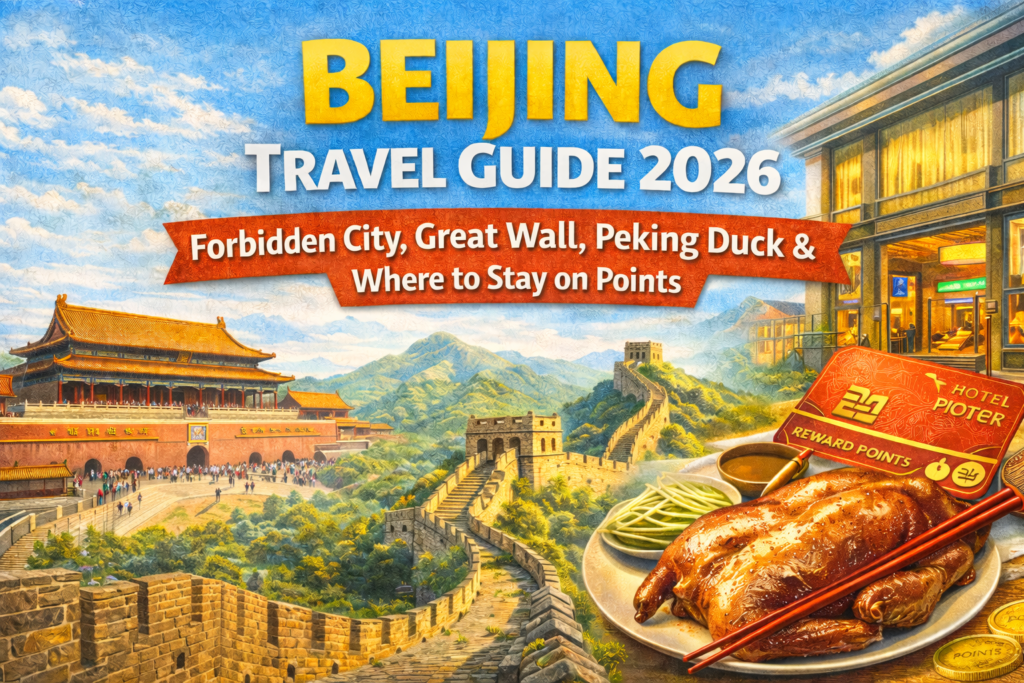
The Forbidden City (Palace Museum) is the largest ancient palace complex in the world — 180 acres, 980 buildings, a million artefacts, and 600 years of Ming and Qing dynasty history concentrated in the centre of Beijing with Tiananmen Square at its southern gate and the Jingshan Park hill directly to the north.
The scale is staggering even after preparation. Walking through the sequence of ceremonial courtyards — the Meridian Gate, the Gate of Supreme Harmony, the Hall of Supreme Harmony, and progressively through the Imperial City’s nested enclosures — takes hours to do properly and delivers a direct physical experience of imperial Chinese power that no photograph or description replicates.
Practical advice: Book tickets online in advance through the official Palace Museum website — same-day tickets are limited and frequently unavailable, particularly in peak season. Arrive at opening (8:30am) to experience the first courtyard before the main crowd density builds. Allow a full morning minimum — a half-day is better.
The Jingshan Park hill immediately north of the Forbidden City provides an aerial view of the entire complex from the pavilion at its summit — the perspective that makes the Forbidden City’s full scale comprehensible. This thirty-minute addition to the Forbidden City visit is strongly recommended.
The Great Wall — Which Section to Choose
The Great Wall is not one experience but many — different sections offer dramatically different character, crowd levels, and accessibility from Beijing.
Mutianyu — the most commonly recommended section for first-time visitors. Well-restored, spectacular scenery, and less crowded than Badaling while still fully accessible on a day trip from Beijing. A toboggan ride down from the wall adds a specific delight unavailable at more austere sections. Accessible by organised day tour or public bus from Dongzhimen station.
Badaling — the most visited section, closest to Beijing, most extensively restored. Genuinely spectacular but extremely crowded during peak season. If crowd density bothers you, choose Mutianyu. If proximity and easy logistics are priorities, Badaling delivers the wall.
Jinshanling and Simatai — for serious hikers who want the less-restored, more dramatic wild wall sections that serious Great Wall walkers seek. Requires more planning and longer transit but rewards the effort with emptier battlements and genuinely remote scenery.
Book Great Wall day trips through Klook for organised transport and skip-the-queue entry at most sections.
Beijing’s Hutong Alleyways — The City’s Soul
The hutong alleyways — traditional narrow lanes running between courtyard residences in the old inner city — are the most intimate and most human-scale part of Beijing. The neighbourhoods around Nanluoguxiang, Shichahai Lake, and Beihai Park contain hutongs that have been continuously inhabited for 700 years and maintain a daily-life texture that the tourist corridors of the major sights don’t offer.
Walking through hutong neighbourhoods — past open courtyard gates revealing families eating dinner, past elderly residents playing chess on low stools, past small local restaurants filling with workers at midday — is Beijing at its least performed and most genuinely alive.
The Nanluoguxiang hutong specifically has become somewhat tourist-facing with boutique shops and cafés alongside the residential lanes — which makes it easier to navigate and slightly less authentically local than the surrounding blocks. Walk Nanluoguxiang and then turn off it into the smaller connecting lanes for the less polished version.
Temple of Heaven — Ritual Architecture at Scale
The Temple of Heaven complex — where Chinese emperors came twice yearly to pray for good harvests — is one of Beijing’s most architecturally extraordinary sites: the circular Hall of Prayer for Good Harvests on its three-tiered marble platform is among the most perfectly proportioned structures in Chinese architecture, and the surrounding park is where Beijing’s residents come in extraordinary numbers to practise tai chi, play music, dance, and simply exist in community.
Arrive early morning — before 9am — when the park is at its most alive with locals and the air has its maximum Beijing clarity. The contrast between the solemn imperial ritual architecture and the joyful, casually social park life happening around it is one of Beijing’s most characteristic experiences.
Wangfujing Walking Street and Snack Street
Wangfujing is Beijing’s most famous shopping and snack corridor — a pedestrian street in the central city flanked by department stores and running to the famous Wangfujing Snack Street (Donghuamen Night Market) where vendors sell everything from scorpions on sticks (more tourist spectacle than local food) to genuine Beijing snacks worth eating.
The department stores along Wangfujing contain the most comprehensive floor-by-floor collections of Chinese goods, food, and culture accessible to visitors without Chinese language skills. The foreign language bookshop on Wangfujing — five floors of Chinese and international books — is worth an hour for travellers interested in China’s literary and cultural production.
Our base at the Hilton Beijing Wangfujing put us steps from this entire area and made spontaneous hutong exploration and Forbidden City visits straightforwardly walkable.
The Food: What to Eat in Beijing
Peking Duck — The Dish That Redefines Itself
Peking duck is Beijing’s most famous culinary contribution to the world — and eating it at a proper Beijing duck restaurant is the experience that makes every overseas Peking duck seem like a pale imitation afterwards. The lacquered skin, crackling with the specific texture of days of air-drying and careful roasting. The tableside carving into precise slices that include both skin and meat. The thin pancakes, the julienned cucumber and scallion, the hoisin sauce — the assembly that the dish demands and rewards.
Where to eat Peking duck in Beijing: Da Dong and Quanjude are the two most internationally recognised restaurants, both excellent. Sihe Yiyuan and other smaller specialist duck restaurants are often preferred by Beijing locals. Book in advance — the best restaurants fill up, particularly for dinner.
Jianbing — Beijing’s Essential Street Breakfast
Jianbing is the Beijing street breakfast — a savoury crepe made on a flat iron griddle, spread with egg, folded with crispy crackers, fermented bean paste, pickled vegetables, and chilli. Made fresh to order from street carts throughout the city in the morning hours, it costs approximately 8–15 RMB (less than $2 CAD) and is one of the most satisfying breakfast street foods in Asia.
Find a jianbing cart near your hotel in the morning — there will be one — and eat it while walking. This is the correct consumption method.
Zhajiangmian — Beijing Noodles
Zhajiangmian — thick wheat noodles with a rich fermented soybean paste sauce, topped with julienned cucumber and bean sprouts — is Beijing’s characteristic noodle dish. Less internationally famous than Peking duck but equally representative of the city’s culinary identity. Available at traditional Beijing restaurants throughout the hutong districts.
The St. Regis Beijing Breakfast
Not street food — but the St. Regis Beijing breakfast, included with our Marriott Platinum Elite status, was one of the most extraordinary hotel breakfast experiences of the entire Asia trip. The spread, the setting, and the specific quality of the service made it a morning experience worth specifically noting in the context of Beijing eating recommendations. Read our St. Regis Beijing review for the full picture.
Where to Stay in Beijing on Points
We stayed at two properties across our Beijing visit — chosen deliberately to cover both the luxury and practical ends of the points redemption spectrum and to use both our central Wangfujing base and the St. Regis splurge night.
Hilton Beijing Wangfujing — Best Location in Beijing
Five nights on Hilton Honors points with the 5th night free benefit. The Wangfujing location is the strongest asset — Forbidden City, Tiananmen Square, the hutong districts, and Wangfujing Street all within walking distance. Clean modern rooms, good Diamond lounge, and the specific pleasure of being able to walk to Beijing’s most significant sites rather than planning subway connections. Read our Hilton Beijing Wangfujing review.
St. Regis Beijing — Best Single-Night Luxury Splurge
One night on a Marriott free night certificate — the most luxurious property we stayed at in Beijing, with grand historic Chinese design, extraordinary evening hors d’oeuvres in the lounge, and the impeccable St. Regis service standard that justifies the certificate deployment. The embassy district location is formal and further from the main attractions — we combined it with the Hilton for the best of both. Read our St. Regis Beijing review.
Hyatt Regency Wangjing Beijing — Best for Modern Beijing
One night on a World of Hyatt free night certificate in the Wangjing business district — modern, spacious, excellent service, and personal for Zee who was returning to Beijing for the first time in over 20 years. The district is quieter and further from central sights but the property quality is outstanding for a certificate redemption. Read our Hyatt Regency Wangjing review.
Check current rates on Agoda for cash bookings across Beijing properties.
Beijing 5-Day Itinerary
Day 1 — Arrive, Wangfujing evening Airport Express to city. Check in. Walk Wangfujing and Snack Street for first Beijing evening. Jianbing from a street cart if you arrive in the morning.
Day 2 — Forbidden City and Tiananmen Full morning at the Forbidden City — arrive at opening. Tiananmen Square after the Forbidden City. Jingshan Park for aerial view of the complex. Afternoon in the hutong neighbourhoods north of the palace.
Day 3 — Great Wall day trip Full day excursion to Mutianyu Great Wall. Book through Klook. Return to Beijing for Peking duck dinner — book in advance.
Day 4 — Temple of Heaven and hutongs Temple of Heaven at opening for morning park life. Afternoon in Nanluoguxiang and the surrounding hutong network. Shichahai Lake evening — bars and restaurants along the lakeside are a pleasant Beijing evening option.
Day 5 — Summer Palace and depart Summer Palace — the imperial garden complex northwest of Beijing, accessible by subway, with a beautiful lake, pavilions, and the famous Long Corridor. Half-day visit before afternoon departure or onward travel.
Practical Information
Visa: China is now visa-free for Canadian passport holders — 90 days without advance application required. Confirm the current policy before travel as visa arrangements can change.
Currency: Chinese Yuan (RMB / CNY). Cash is still needed for some smaller vendors and markets — bring some RMB. WeChat Pay and Alipay are the dominant payment methods for locals; international tourists can now link foreign credit cards to both apps for wider cashless payment access.
Language: Mandarin Chinese. English is limited outside international hotels and major tourist sites. Download Google Translate with offline Chinese language pack before arrival (requires VPN). Translation apps are genuinely essential for restaurant menus and street navigation outside the main tourist corridors.
VPN: Essential. Download and activate before arriving in China — VPNs are difficult or impossible to download from within the country. ExpressVPN and NordVPN both work reliably in China.
Connectivity: Set up a China e-SIM through Airalo before arrival — 10% off with our link. Note that e-SIM data from foreign providers still requires a VPN for most Western apps.
Weather: Beijing has four distinct seasons. Spring (April–May) and autumn (September–October) are the most pleasant — clear skies, comfortable temperatures, the city at its most beautiful. Summer is hot and occasionally hazy. Winter is cold and dry with infrequent snow. March to May and September to November are the recommended windows.
Air quality: Beijing’s notorious air quality has improved significantly over the past decade but remains variable. Check AQI (Air Quality Index) before planning outdoor-heavy days. High-AQI days are best spent at indoor attractions — the Palace Museum, the National Museum, the 798 Art District.
Frequently Asked Questions
Do Canadians need a visa for China in 2026? No — China extended visa-free entry to Canadian passport holders, allowing 90-day stays without advance visa application. Confirm the current policy remains in effect before booking, as international visa arrangements are subject to change.
What is the best area to stay in Beijing? The Wangfujing and Dongcheng districts offer the best combination of location and walkability for first-time visitors — close to the Forbidden City, hutong neighbourhoods, and major sights. The embassy district (where the St. Regis is located) is quieter and more formal, better for one luxurious night than as a full-trip base.
How many days do you need in Beijing? Five days covers the essential experiences without rushing. Three days is workable for a highlights-only visit. A week allows deeper hutong exploration, day trips beyond the Great Wall, and the slower pace that Beijing’s depth rewards.
Is Beijing safe for tourists? Yes — Beijing is very safe for international visitors. Standard urban awareness applies. Petty scams targeting tourists exist in some high-traffic areas (particularly around Tiananmen Square) but serious crime against tourists is rare.
What is the best Great Wall section to visit from Beijing? Mutianyu for most first-time visitors — spectacular scenery, well-restored, less crowded than Badaling, with the toboggan descent adding a genuinely fun element to the experience. Jinshanling for serious hikers wanting the wilder, less-restored wall experience.
How do I get around Beijing? Beijing subway for all major sites — comprehensive, bilingual, affordable. Didi for ride-hailing when the subway is inconvenient. Walking for the hutong districts and areas around the Forbidden City where pedestrian exploration is the best option.
Final Thoughts
Beijing requires multiple visits to approach properly — the history is too deep, the neighbourhoods too varied, and the city too large for any single trip to feel comprehensive. What five days provides is an introduction of sufficient depth that the city stops being abstract and starts being understood.
The Forbidden City will be larger than you imagined. The Great Wall will be more beautiful than the photographs suggested. The Peking duck will redefine your relationship with a dish you thought you already understood. And the hutong alleys — particularly at that specific early morning hour when the city is waking up and residents are going about their daily lives in spaces that have been used the same way for seven centuries — will be the memory that lasts longest after everything else has faded.
Go. The visa barrier is removed. There has never been a more straightforward time for Canadians to visit China.
Check hotel rates on Agoda. Book Great Wall day trips and Forbidden City tickets through Klook. For our full Beijing hotel reviews: St. Regis Beijing, Hilton Beijing Wangfujing, and Hyatt Regency Wangjing.
For our complete Asia trip, start at our Asia trip overview.
Follow our journey: Instagram @angeandzee | TikTok @angeandzee